


![[중등] (2권) 인문독서 - 깊은 독해와 사고](https://i1.gguge.com/r/product/8f3180ca-ae05-4c84-b401-71cb73eb02d0.png.webp?w=1280)
[중등] (2권) 인문독서 - 깊은 독해와 사고
0
(0)
2,500년 인류 최고의 고전 문학·철학을 읽으며 중등 비문학 독해력과 사고력을 함께 키우는 인문독서논술 수업입니다. 단순 독서에서 끝나지 않고, 읽은 내용을 바탕으로 요약·정리·논술·글쓰기까지 연결합니다. 철학 고전과 문학 고전을 아이 눈높이에 맞춰 쉽게 풀어내며, 독해력·사고력·문장력의 근본 체력을 다집니다.
4%25,000G(US$17.25)
Per Session
Subscription
14-16
Max 4people
45min

이지훈
Reviews
315
📌 본 수업은 99% 재수강율을 자랑하는 분당·판교 지역 명문 독서논술 학원의 고전인문철학수업과 인문독서 강의를 온라인 수업으로 구성한 과정이며, '중등 인문독서 - 깊은 독해와 사고'의 2권 수업입니다. (총 6권)
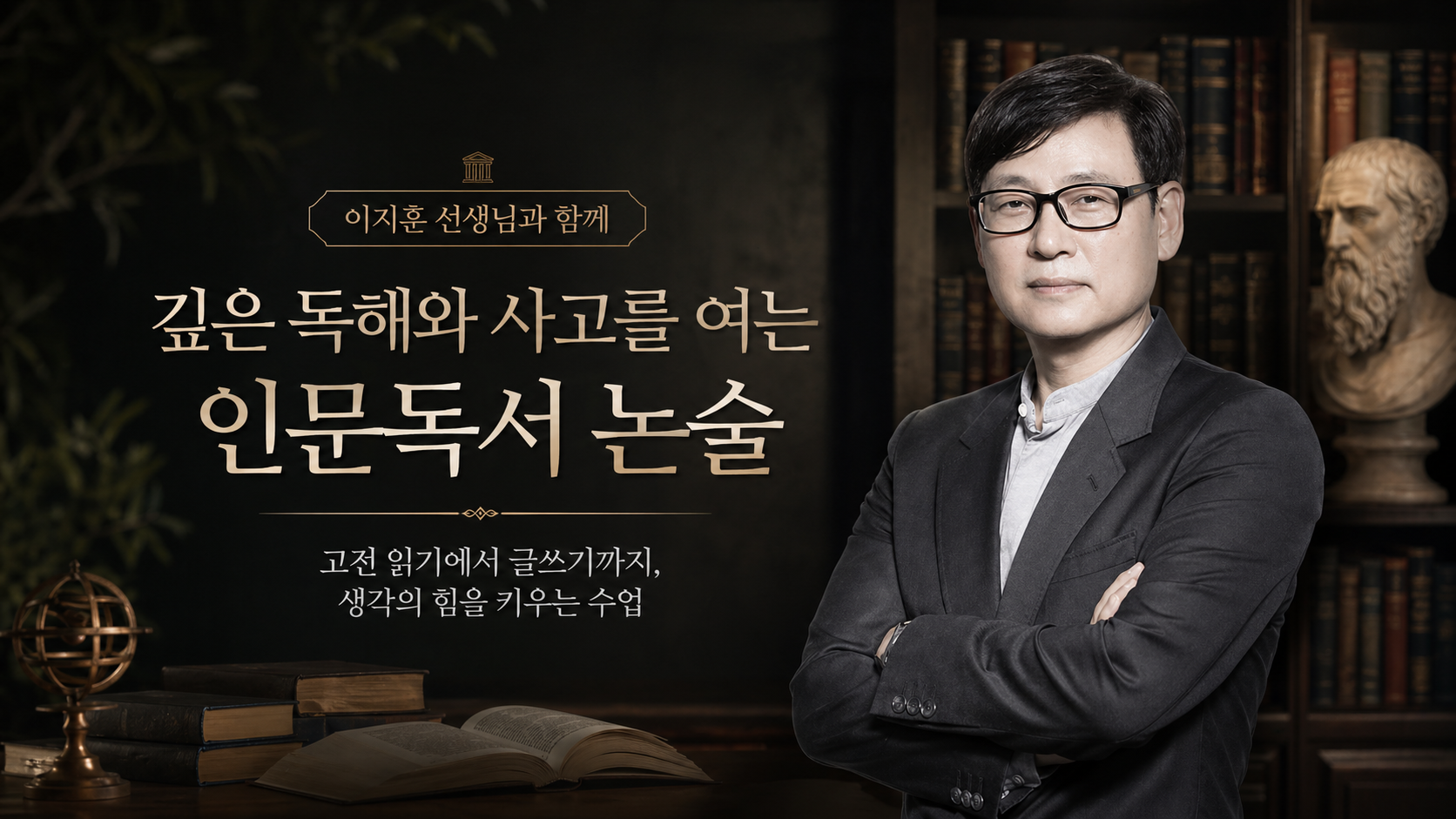
중등 비문학 독해를 넘어,
깊은 사고력과 글쓰기까지 키웁니다
긴 글을 읽고도 핵심을 놓치거나,
생각은 있지만 글로 정리하기 어려운 학생이라면
이제는 ‘깊이 읽는 독서’가 필요합니다.
2,500년 인류 최고의 고전 문학·철학을 통해
아이의 생각의 깊이와 사고의 그릇을 키웁니다.
단순히 책을 읽고 감상을 나누는 수업이 아닙니다.
고전 문학과 철학 텍스트를 바탕으로
텍스트를 읽고, 핵심을 정리하고,
자신의 생각을 논리적인 글로 표현하는 과정까지 연결하며,
중등 비문학 독해력과 사고력을 차근차근 다집니다.
문학 고전부터 철학 고전까지
아이 눈높이에 맞춰 쉽게 풀어내며,
독해력·사고력·문장력의 근본 체력을 함께 길러갑니다.
📚 커리큘럼 안내
(총 16회차, 한 주제로 2회차씩 수업)
*각 강의는 독립적으로 구성되어, 시리즈 중간에 합류 가능합니다.
9강. 제3의 탄생에 대하여 (베이컨, 신논리학)
10강. 꿈의 구조도에 대하여 (한비, 한비자)
11강. 생각의 지도에 대하여 (통합사유철학강의)
12강. 숭고한 나눔에 대하여 (칼릴지브란, 예언자)
13강. 명예로운 삶에 대하여 (아우렐리우스, 명상록)
14강. 우리에게 중요한 것들에 대하여 (생텍쥐페리, 어린 왕자)
15강. 삶의 목적에 대하여 (장자)
16강. 참과 진리에 대하여 (니체, 반시대적 고찰)
✍🏻 학생은 이렇게 변화합니다
학생은 긴 글에서 핵심 주장과 근거를 구분해 읽고,
텍스트를 요약·정리하며
자신의 관점을 세우는 사고 구조를 기르게 됩니다.
또한 매 회차 글쓰기 과제를 통해
읽은 내용을 근거로 주장과 이유를 세우고,
자신의 판단을 문장과 글로 완성하는 경험을 쌓게 됩니다.
따라서 이런 학생에게 추천합니다.
비문학 지문을 읽어도 핵심을 잡기 어려운 학생
긴 글의 내용을 요약하고 정리하는 데 시간이 오래 걸리는 학생
독후감이나 논술형 글쓰기에서 주장과 근거 연결이 어려운 학생
생각은 있지만 문장으로 구조화하는 방법이 필요한 학생
문학·철학·고전 텍스트를 바탕으로 사고력과 글쓰기 기초를 함께 다지고 싶은 학생
단순 독서가 아니라 독해, 사고, 표현까지 연결되는 수업을 원하는 학생
👩🏫 선생님 이력 및 경력
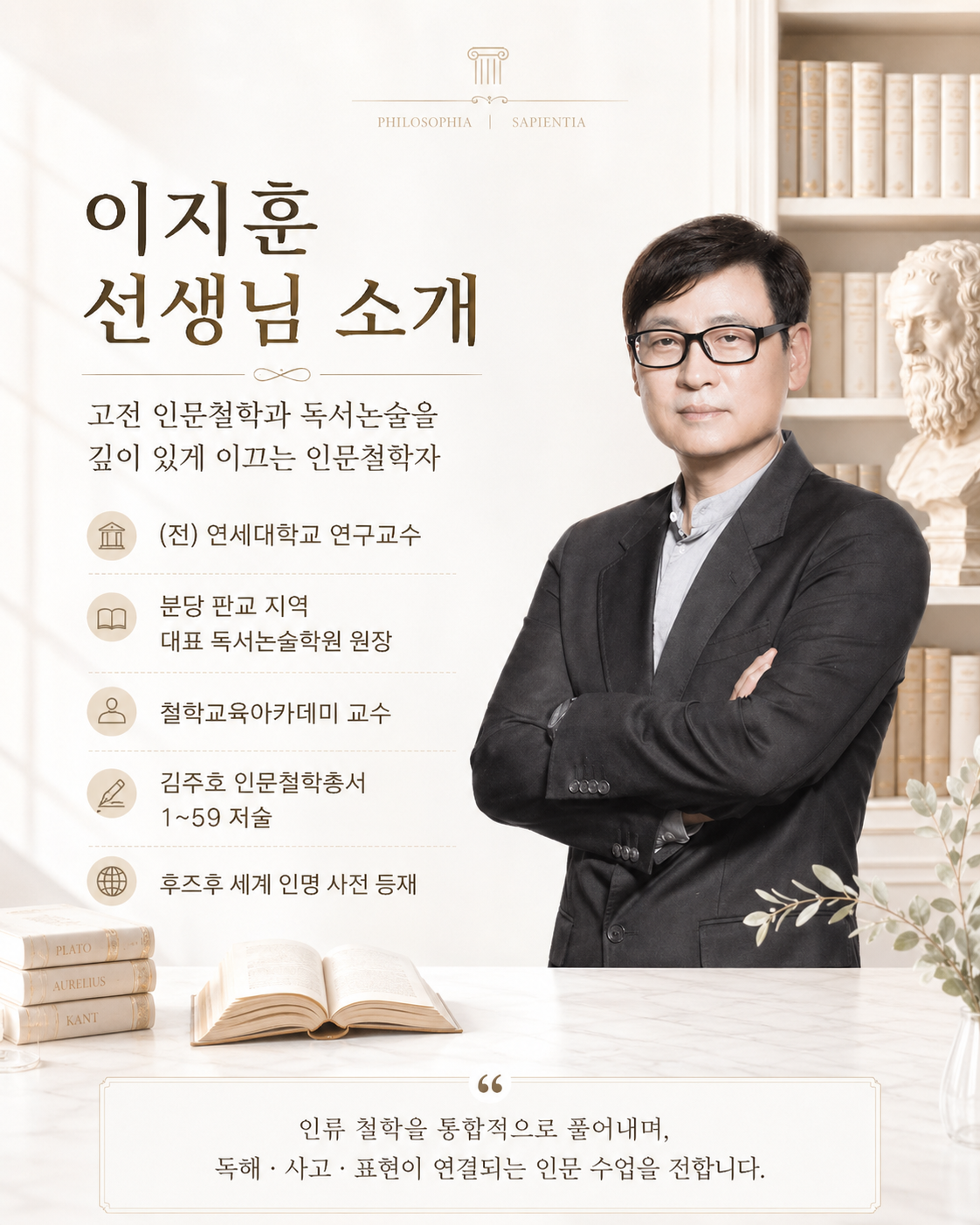
이지훈 선생님
(전) 연세대학교 연구교수
분당·판교 지역 대표 독서논술학원 원장
철학교육아카데미 교수
김주호 인문철학총서 1~59 저술
고전인문철학수업 1~6 포함
인문철학교육서 포함
❓ 왜 이 수업이 필요한가요?
중등 이후의 독서는
단순히 많이 읽는 것만으로는 충분하지 않습니다.
긴 글을 읽고 핵심을 파악하는 힘,
복잡한 생각을 정리하는 힘,
자신의 관점을 근거와 함께 표현하는 힘이 필요합니다.
특히 비문학 독해와 논술형 글쓰기에서는
글을 읽은 뒤 핵심 주장과 근거를 구분하고,
자신의 생각을 논리적인 문장으로 정리하는 능력이 중요합니다.
이 수업은 고전 문학·철학 텍스트를 바탕으로
독해, 사고, 표현을 함께 훈련하며
중등 비문학 독해와 글쓰기의 기초 체력을 길러줍니다.
📌 그래서 준비한, 이 수업
이 수업은 고전 문학과 철학 텍스트를 활용해
독해–사고–표현을 연결하는
인문독서논술 수업입니다.
수업에서는 다음 흐름을 반복합니다.
회차 주제에 맞는 고전 텍스트 읽기
핵심 주장과 근거 파악하기
독서노트 형태로 내용과 관점 정리하기
논술·글쓰기 과제로 주장–근거–예시를 갖춘 글쓰기
회차에 따라 그림 논술, 음악 논술, 추가 독서노트 등 확장 활동 진행
단순히 고전을 읽는 데서 끝나지 않고,
읽은 내용을 바탕으로 생각을 정리하고
글로 표현하는 힘까지 기르는 수업입니다.
🌟 이 수업이 특별한 이유
1. 고전 기반의 독해–사고–표현 통합 구조
고전 문학·철학 텍스트를 읽고
핵심 내용을 정리한 뒤
글쓰기까지 연결합니다.
읽기에서 끝나는 수업이 아니라,
생각을 정리하고 표현하는 과정까지 함께 훈련합니다.
2. 매 회차 논술·글쓰기 반복 훈련
읽은 내용을 바탕으로
주장과 이유를 세우는 연습을 합니다.
학생은 고전 텍스트를 통해
자신의 생각을 정리하고,
논리적인 문장으로 표현하는 경험을 쌓게 됩니다.
3. 독립 구성 커리큘럼으로 중간 합류 가능
각 강의는 독립적으로 구성되어 있어
시리즈 중간에 참여해도 부담이 적습니다.
관심 있는 주제부터 시작하며
고전 인문독서의 흐름을 차근차근 경험할 수 있습니다.
4. 다양한 매체 활동을 통한 표현 확장
주제에 따라
그림 논술, 음악 논술, 독서노트 등
활동형 과제를 포함합니다.
텍스트를 읽고 끝나는 것이 아니라,
다양한 방식으로 생각을 확장하고 표현합니다.
✅ 수업 운영 방식
1. 독해
회차 주제에 맞는 고전 텍스트를 읽고
핵심 내용을 파악합니다.
2. 정리
독서노트 형태로
핵심 내용과 자신의 관점을 정리합니다.
3. 글쓰기
논술·글쓰기 과제로
주장–근거–예시를 갖춘 문장과 글을 작성합니다.
4. 확장 활동
회차에 따라
그림 논술, 음악 논술, 추가 독서노트 등
활동형 과제를 포함합니다.
📍 교재 안내
수업 자료는 아래 두 가지 방식 중 선택해 준비할 수 있습니다.
자료실에 첨부된 파일을 인쇄하여 교재로 사용
서점 판매 중인 『고전인문철학수업 2권』 김주호 저 구매 후 사용
고전은 어렵게 외우는 책이 아니라,
생각의 깊이를 키우는 가장 좋은 질문입니다.
읽고, 정리하고, 쓰는 과정을 통해
중등 독해력과 사고력의 바탕을
단단하게 만들어보세요.
Curriculum
Total 16 sessions
Session 1
9강. 제3의 탄생에 대하여 (베이컨, 신논리학)
1. 나에 대하여 : 정리된 자신의 2단계 목표(가치를 위한 꿈)를 바탕으로 그것을 달성하기 위해 해야 할 일 15가지를 도출하고, 그 중 가장 중요 한 일, 3가지를 선택하시오. 2. 고전 읽기 : 베이컨, 신논리학 3. 주제 토론 : 제3의 탄생 4. 천자문 / 명심보감 5. 독서 노트 : 어린왕자에 흐르는 정신에 대하여
Session 2
9강. 제3의 탄생에 대하여 (베이컨, 신논리학)
1. 나에 대하여 : 정리된 자신의 2단계 목표(가치를 위한 꿈)를 바탕으로 그것을 달성하기 위해 해야 할 일 15가지를 도출하고, 그 중 가장 중요 한 일, 3가지를 선택하시오. 2. 고전 읽기 : 베이컨, 신논리학 3. 주제 토론 : 제3의 탄생 4. 천자문 / 명심보감 5. 독서 노트 : 어린왕자에 흐르는 정신에 대하여
Session 3
10강. 꿈의 구조도에 대하여 (한비, 한비자)
1. 나에 대하여 : 자신의 꿈 속에서 나를 위한 일 다섯 가지 (FM), 우리를 위한 일 다섯 가지 (FU),사람들을 위한 일 다섯 가지 (FP)를 기술하 시오. 2. 고전 읽기 : 한비자 3. 주제 토론 : 제3의 탄생과 꿈의 구조도의 관계 4. 천자문 / 명심보감 5. 논술 / 글쓰기 : 사형제도는 정당한가? 6. 독서 노트 : 그리스 로마 신화
Session 4
10강. 꿈의 구조도에 대하여 (한비, 한비자)
1. 나에 대하여 : 자신의 꿈 속에서 나를 위한 일 다섯 가지 (FM), 우리를 위한 일 다섯 가지 (FU),사람들을 위한 일 다섯 가지 (FP)를 기술하 시오. 2. 고전 읽기 : 한비자 3. 주제 토론 : 제3의 탄생과 꿈의 구조도의 관계 4. 천자문 / 명심보감 5. 논술 / 글쓰기 : 사형제도는 정당한가? 6. 독서 노트 : 그리스 로마 신화
Session 5
11강. 생각의 지도에 대하여 (통합사유철학강의)
1. 나에 대하여 : 1장~10장까지의 철학자들이 가르치는 가치와 정신에 대하여 기술하고, 그것을 자신의 꿈에 어떻게 적용할지 깊이 고민하여 설명하시오. 2. 독서 : 통합사유철학강의 3. 주제 토론 : : 생각의 지도 4. 천자문 / 명심보감 5. 논술 / 글쓰기 : 경쟁은 나쁜 것인가? 6. 독서 노트 : 보물섬 (로버트 스티븐슨)
Great for These Kids
중등 비문학 독해를 학습하고 싶은 친구
독해력, 사고력, 문장력 등 글쓰기 능력을 키우고 싶은 친구
인문, 철학 지성을 갖춘 공동체 리더로서 성장하고 싶은 친구
중등 과정 대응하여 수업 진행합니다.
Subscription Class Information
A renewal payment for the next session is automatically processed immediately after each class ends. You may unsubscribe at any time.
If a session cannot be held due to the teacher, you will be notified by email.
The charge for any session that does not take place will be processed as 0G.
Teacher Info
Auto-translated to English.
이지훈
Reviews
315
Writing education is not about teaching how to write, but rather a process that expands the depth and capacity of thought. We enrich the ocean of children's thoughts with depth and profoundness through the reading of the greatest humanities classics of the past 2,500 years. <Instructor Introduction> The instructor is a humanities philosopher and introspective writer dedicated to reinterpreting and popularizing human philosophy from an integrated perspective. He proposes and pioneers a unique philosophical approach called "Integrated Philosophy of Thought." His writings explore fundamental questions of human existence—namely, who we are and how we should live—leading readers to seek the path to true happiness and self-realization. 1. Construction of a Philosophical System and Integrated Philosophy of Thought The instructor proposes a unique philosophical system called "Integrated Philosophy of Thought" and has reconstructed 2,500 years of human philosophy into a three-dimensional coordinate system. Taking "Existence," "Will," and "Cognition" as the fundamental axes, he analyzes the structure of thought in a three-dimensional manner by introducing their opposite concepts: "Anti-Existence," "Anti-Will," and "Anti-Cognition." Through this, he comprehensively illuminates diverse philosophical ideas ranging from Plato to Nietzsche, leading an innovative attempt to transform philosophy from a "domain for a select few experts" into a "tool for everyday thinking." 2. Activities as an Educator He focused on the popularization of philosophy. Conducting the *Lectures on Integrated Philosophy of Thought* in various educational settings, he classified the history of human thought into eight spaces (e.g., the space of thought expression, the space of nihilism) and delivered lectures that explored the direction of life through these categories. Furthermore, in his *Classical Humanities Philosophy* course, he enhanced the accessibility of humanities philosophy education by integrating philosophy with literary works such as *Aesop's Fables*, *The Little Prince*, *Demian*, *The Republic*, and *Zhuangzi*. 3. Major Writing Activities Most of his works reinterpret the fundamental elements of human existence and present a path toward deeper self-realization and happiness. *Lectures on the Philosophy of Integrative Thought*: A representative work that systematizes human philosophy, it has been widely distributed since the first edition was published in 2014. *Things the Cool Breeze on a Joyful Summer Night Teaches*: A humanities book on the themes of existential healing and self-reflection that conveys hope to readers experiencing the futility of life. *No Need for Happiness*: It demotes happiness from the "sole goal of life" to a "secondary result." 4. Academic Vision He redefines philosophy as an integrative "map of life" and emphasizes "freedom and spiritual equality." For example, in *Lectures on the Philosophy of Integrative Thought*, he argues that "human recovery begins with freedom and equal thought," presenting social healing through autonomous individual thought. Furthermore, to innovate education in the digital age, the accessibility of philosophy learning has been enhanced by utilizing various technological tools and platforms. • Integrated Philosophy of Thought: The author understands human life along three axes: "Existence, Will, and Perception," believing that true happiness and truth can only be realized when these three elements are in harmony. Based on this philosophical framework, his books present concrete methods for individuals to reach happiness through introspection and continuous practice. • The Value of Practice and Practice: Beyond the mere transmission of theory, his writings emphasize that happiness is not attained overnight but is achieved gradually through ceaseless self-improvement and practice. The "Book of Truth" series provides specific guidelines on how a proper attitude toward life and self-reflection transform an individual and help them internalize inner truth. • A Self-Reflective Approach: The author criticizes existing perceptions trapped within frameworks imposed by flawed education or society, and encourages readers to discover new truths through their own experiences and emotions. Through this, he encourages readers to engage in a process of actively rediscovering themselves, rather than adopting a passive attitude of merely waiting for happiness. 5. Evaluation and Influence His work is regarded as practical philosophy that transcends mere academic research. His integrative approach enables the intuitive understanding of complex philosophical concepts and induces readers to explore the fundamental question, "Who am I?" in a new light. In particular, his "Eight Spaces of Thought" theory serves as a tool for systematically interpreting individual mental confusion, thereby proving the practical value of philosophy. In summary, the author is a pioneer who has brought philosophy out of the boundaries of academia and connected it to practical application in daily life. His work contributes to the popularization of the humanities and the spiritual recovery of modern society, enabling a rediscovery of the power inherent in philosophical thought. The significance of the author's writing lies not merely in philosophical contemplation, but in providing practical methods for each of us to overcome the anxiety, loneliness, and confusion we experience in our daily lives and to recover our true selves. His writings contain philosophical depth alongside warm comfort and practical guidance, motivating readers to reflect on and improve their own lives. Crossing the boundaries between humanities and self-help, the author is regarded as a writer who offers deep reflection and practical wisdom to readers seeking to explore the essence of life. <Kim Ju-ho Humanities Philosophy Series> Series 1. Lectures on Integrated Philosophy of Thought Series 2. On Existence [The Self] Series 3. Things the Cool Breeze of a Joyful Summer Night Teaches ~ Series 58. Encounter with Eight Selves Series 59. Happiness Is Not Necessary
Experience & Activities
·
(Former) Research Professor at Yonsei University
·
Director of the leading reading and writing academy in the Bundang Pangyo area
·
Professor at the Academy of Philosophy Education
·
Authored Kim Ju-ho Humanities Philosophy Series 1–59 (including Classical Humanities Philosophy Classes 1–6 (Series 13–18) and Humanities Philosophy Education Textbooks)
·
Listed in Who's Who World Biographical Dictionary
See Full Teacher Profile
Class Reviews
Growth Reviews for This Class