


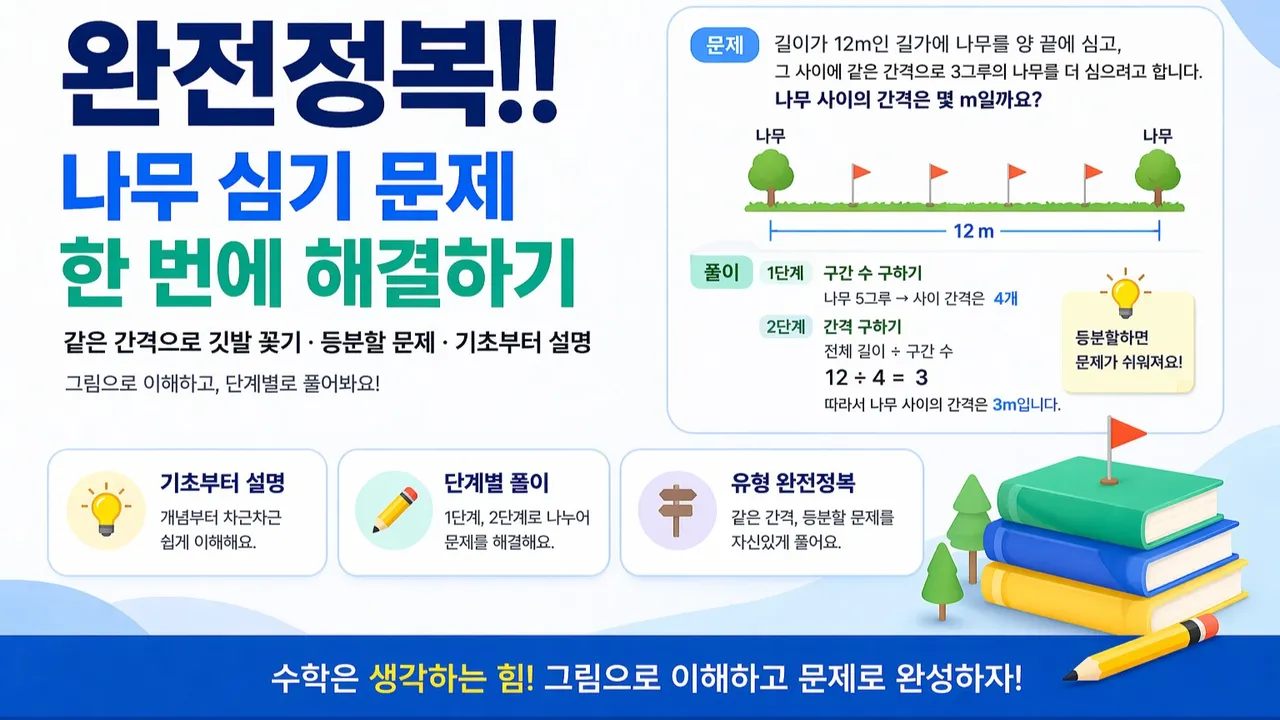
완전정복!! 나무 심기 문제 한 번에 해결하기 : 같은 간격으로 깃발 꽂기 : 등분할 문제 : 기초부터 설명
0
review 0
일정한 간격으로 나무를 심거나 깃발을 꽂는 문제는 "기수" 개념이 포함되어 있습니다. 이 개념을 정확히 익히고 등분할을 이용하면 거의 대부분 나무 심기와 같은 문제는 풀 수 있게 됩니다. 그리고 그림으로 문제를 이해하면 더 쉽게 해결됩니다. 이 수업은 기수, 등분할, 그림으로 표현하여 문제 해결하기를 기초부터 차근차근 설명합니다.
10%30,000G(US$20.70)
22,000G(US$15.18)
Class Type
One Day
Ages
11-13
Class Size
Max 5people
Duration
40min
Replay

구자익
Reviews
146
🌳 수업을 통해 이런 실력이 자라나요
나무 심기와 깃발 꽂기 같은 '등분할' 문제를 혼자 힘으로 풀 수 있어요.
헷갈리는 기수, 등분할 개념을 쏙쏙 내 것으로 만들 수 있어요.
머릿속이 복잡한 문제도 그림으로 쉽게 풀이하는 습관이 생겨요.
수학적 사고력과 문제를 차근차근 풀어나가는 힘이 커져요.
✍️ 수업 내용 3줄 요약
등분할과 기수 개념을 간단한 예제로 친절하게 설명해요.
나무 심기, 깃발 꽂기 등 대표 문제를 다양한 방법으로 풀어봐요.
그림이나 도식화를 통해 문제를 쉽고 재밌게 이해해요.
🌈 이런 친구에게 특히 추천해요
나무 심기, 깃발 꽂기처럼 자주 헷갈리는 문제에 자신이 없는 친구
수학 문제를 풀 때 '그림으로 한 번에!' 생각하면 막막한 친구
초등 교과 수학을 정확하게 이해하고 넘어가고 싶은 학생
스스로 문제 해결력을 키우고 싶은 11세 이하 초등학생
🧩 등분할, 왜 이렇게 많이 나올까요?
학교 시험, 경시대회, 심지어 중고등 수학에서도 ‘등분할’은 계속 등장해요. 특별히 어려울 것 없다는 걸, 한 번만 제대로 배우면 알 수 있어요. 이 수업에서는 기수와 등분할 원리를 그림과 스토리로 풀어서, ‘왜 이런 방식으로 푸는지’ 한눈에 이해할 수 있게 설명할 거예요. ‘감으로 대충’ 푸는 게 아닌, 머리와 손으로 정확하게 연습하며 진짜 실력을 만들 수 있어요!
⏰ 수업 흐름은 어떻게 되나요?
인사-오늘의 주제 소개 (3분)
기수, 등분할 기초 개념 잡기-여러 사례로 살펴보기 (10분)
나무 심기, 깃발 꽂기 다양한 문제 풀이 (15분)
함께 그림으로 문제 해결하기-직접 그리며 이해하기 (7분)
오늘의 내용을 자연스럽게 복습하며 마무리 (5분)
이 수업으로, 수학 문제를 보는 눈이 완전히 달라질 거예요. 그림으로 이해하고, 논리적으로 답을 찾아가는 재미를 꼭 느껴보세요!

If you cancel within 48 hours of the scheduled class, a cancellation fee will apply based on the timing of cancellation.
If you cancel more than 48 hours before the scheduled class, a full refund will be issued with no cancellation fee.
To reschedule, please cancel and rebook.
If the teacher cancels the class, you will receive a full refund and any coupons used will be restored.
Teacher Info
Auto-translated to English.
구자익
Reviews
146
Graduated from Korea University (Seoul Campus) Served as the Director of a renowned academy in the Gangnam 3-gu district for over 15 years Personally produced over a dozen textbooks for elementary, middle, and high school students Taught a student who achieved a perfect score on the 2016 CSAT starting from their first year of high school. For 15 years, I taught middle school classes for medical school and top-tier students, as well as high school classes for Grade 1 students and Grade 1 CSAT students in the Gangnam 3-gu district of Seoul. As an academy director for 10 years, I gained diverse experience teaching students of various levels. In particular, the teacher has the strength of reading students' thoughts, quickly identifying their habits, and presenting appropriate countermeasures and methods. Through the teacher's diverse teaching experience and student observations, countless students have gained confidence in mathematics and improved their grades. Mathematics is a discipline that organizes complex thoughts and aids in problem-solving. In other words, it is a subject that is truly essential to us. However, nowadays, students view mathematics as a subject where they must memorize concepts and theories (without critical analysis) and repeatedly solve problems by type (without knowing why they are solved that way). Mathematics is based on operations, and as students advance through the grades, they must learn by connecting and expanding upon new concepts and theories with what they have already learned. However, students who strongly believe that mathematics is solely about operations face limitations because they view the subject through this single lens. Consequently, the better a student's calculation skills are, the more difficult middle school mathematics feels. This difficulty is experienced again when learning high school mathematics. Mathematical concepts and theories require students to develop a habit of proactively understanding them, while problem-solving requires problem analysis and solution strategies. Only by learning "the connection and expansion of mathematical concepts" and "problem analysis, understanding, and problem-solving strategies" will students realize that mathematics is simple and easy as time goes by. The teacher will help students come to this realization. The teacher's teaching method is somewhat unique. 1. The teacher explains "why" concepts and theories are necessary, "how" they are expressed in a particular way, and "what" they connect to among previously learned concepts. 2. The teacher provides students with the opportunity to express their own thoughts. This allows the teacher to distinguish between well-thought-out ideas and those that need correction. 3. Understand the student's thought process regarding 'how' they solved the problem. 4. Teach how to analyze and understand problems, and the starting point for solving them. 5. Do not teach by categorizing problems into types. Therefore, do not teach solution methods by categorizing them either. 6. Regularly check whether the student solved the problem correctly (logically), and encourage them to express their thoughts verbally (verbal expression helps them identify their weaknesses).
Education & Certifications
Department of Physics, Korea University
Graduated
Experience & Activities
·
Teaching middle and high school subjects to middle and high school students for approximately 20 years
·
Coaching for various competitions such as KJMO, KMO, and AMC
·
Producing numerous successful applicants to electronics high schools and specialized high schools
·
Producing numerous students with Grade 1 high school GPA and CSAT scores in the Gangnam 3 districts for over a decade
·
Produced perfect scorers on the CSAT (2016 academic year)
·
Selling books personally created by the teacher at Kyobo Book Centre (search for JIK)
·
International school IB classes or AP courses (Pre-Algebra, Algebra, Geometry, Combination, Number Theory, Pre-Calculus, Calculus)
See Full Teacher Profile
Class Reviews
Growth Reviews for This Class


