


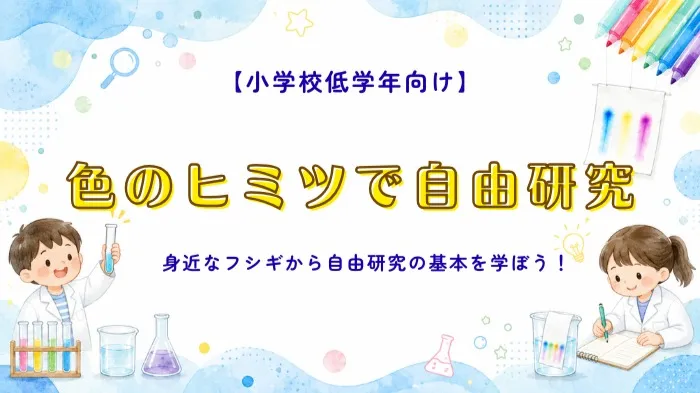
【小学校低学年向け】色のひみつを見つけよう!自由研究の観察や記録のコツも学べる!
0
(0)
水を使ってインクの色を分ける「クロマトグラフィー」に挑戦します。 「黒色には本当に黒しか入っていないの?」という不思議を体験しながら、自由研究に欠かせない「予想する・観察する・記録する」の基本を学びます。 さらに、水性ペンの色やメーカーなど、どんな条件を比べると自由研究になるのかも紹介。 実験を楽しむだけでなく、自分だけの研究へ発展させるヒントが見つかる講座です。
One Day
6-10
Max 4people
45min
前田早弥
Reviews
0
「自由研究ってどうやって進めたらいいの?」
「実験はできても、何を見ればいいのか分からない…」
そんなお子さまにぴったりの講座です。
この講座では、水を使ってインクの色を分ける「クロマトグラフィー」という実験を楽しみながら、自由研究で大切な
「予想する」
「よく観察する」
「記録する」
という3つの力を身につけます。
実験をして終わりではなく、
「どんなことを比べると自由研究になるの?」
「どうやって記録すると伝わりやすいの?」
というポイントも分かりやすく学びます。
🌈授業後、お子さまはこのように成長します🌈
・実験をしながら「予想→実験→結果」の流れで考えられるようになります。
・色の変化をよく観察し、自分の言葉や絵で記録できるようになります。
・実験を「楽しかった」で終わらせず、研究へ発展させる視点が身につきます。
🍀授業内容🍀
・クロマトグラフィーでインクの色を分ける実験
・色の変化を観察し、発見をアウトプットする方法
・「条件を変えて比べる」自由研究の考え方
✨こんなお子さまにおすすめ✨
・自由研究を何から始めればよいか分からないお子さま
・実験や色の変化を見ることが好きなお子さま
・観察したことからまとめる力を身につけたいお子さま
🌱準備物🌱
・コーヒーフィルターやキッチンペーパー(2~3枚)
・水性カラーペン(黒を含む3~5色程度)
・コップまたは透明な容器(1個)
・水
・はさみ
・セロハンテープまたはクリップ
・記録用の筆記用具
※汚れが気になる場合、トレイや汚れてもいい服もご用意下さい。
Great for These Kids
自由研究のテーマは決まったけれど、進め方が分からないお子さま
自由研究のテーマは決まったけれど、進め方が分からないお子さま
夏休みの自由研究を楽しく始めたいお子さま
観察や記録のコツを身につけたいお子さま
はさみを安全に使うことが難しいお子さま(保護者のサポートがあれば参加可能です。)
水性ペンや水を使った簡単な実験が難しい環境で受講される方
One Day Class Information
If you cancel within 48 hours of the scheduled class, a cancellation fee will apply based on the timing of cancellation.
If you cancel more than 48 hours before the scheduled class, a full refund will be issued with no cancellation fee.
To reschedule, please cancel and rebook.
If the teacher cancels the class, you will receive a full refund and any coupons used will be restored.
Teacher Info
Auto-translated to English.
前田早弥
Reviews
0
Hello. I'm a science instructor who leverages my experience as a PhD in science, having conducted research at universities and companies, to help children discover the joy of learning. What I value most is not simply teaching knowledge, but rather helping children experience the fun of thinking, experimenting, and discovering for themselves. Science isn't a subject where you memorize correct answers. It starts with small curiosities like, "Why?" "I want to try!" The process of making predictions, experimenting, thinking, and trying again is what I believe true learning is. In my lessons, I emphasize experiences that transform "Wow!" into "Aha!" through experiments and observations using everyday materials. Even if the results differ from expectations, it's not a failure, but a new discovery. I strive to create an atmosphere where children feel safe and comfortable trying new things. On the other hand, what I truly want to cultivate isn't just scientific knowledge. Each child has different "likes," "strengths," and "passions." For example, some children enjoy observation. Some children excel at crafts. Some children enjoy explaining things to their friends. Some children repeatedly ask "why?" These differences are what make each child unique, and I believe they are the seeds of their future strengths. That's why, even in lessons, I don't just end with "That was fun," but instead I value dialogue such as: "What did you enjoy the most?" "What excited you?" "What would you like to try next?" It's not just about acquiring knowledge; it's about discovering one's own interests and preferred learning styles. I believe this leads to self-understanding and the ability to continue learning independently. Furthermore, while incorporating learning from StrengthsFinder (CliftonStrengths) and coaching, I value the idea that "everyone is different" and "everyone has their own unique way of learning." More than whether a child is good or bad at studying, I believe that discovering together "what motivates them" "what they can become engrossed in" is the first step in fostering children's self-esteem and initiative. As a researcher, mother, and educator, I've witnessed countless instances where "what you discover through experimentation is more memorable than being given the correct answer." That's why, in my lessons, I prioritize "time for children to think, discuss, and experiment" over "time for the teacher to instruct." I want to create a learning environment where children naturally feel, "I want to learn more because it's interesting!" rather than "I have to work hard because it's studying." Children who love science are welcome, of course, but so are those who "struggle a little with science but love experiments," "find it difficult to ask questions at school," or "want to discover what they love." We value each child's desire to "try," and provide a time where they can learn and grow in their own way.
Experience & Activities
·
20 years of research experience, from university to major chemical manufacturer.
·
We have held over 20 real science workshops at public facilities such as elementary schools and community centers.
·
Over 150 online science courses have been held in total.
·
We are always accepting applications for individualized science lessons and support for independent research projects tailored to each family.
·
As a self-understanding coach, I provide one-on-one support to help you discover what you truly want to do.
See Full Teacher Profile
Class Reviews
Growth Reviews for This Class