


![[심화] AI 시대에 살아남는 생각설계 심화 논술](https://i1.gguge.com/r/product/b4a7124f-f1d5-470f-88d9-2ba8e36d4bcf.png.webp?w=1280)
[심화] AI 시대에 살아남는 생각설계 심화 논술
0
(0)
정답을 빠르게 찾는 일은 이제 AI가 대신합니다. 입시 역시 외운 지식을 묻는 대신, 스스로 판단하고 근거를 세워 상대를 설득하는 비판적 사고력을 평가합니다. 본 수업은 매주 세상을 흔드는 12가지 사회 이슈를 신문 기사로 만나 찬성과 반대 입장을 정밀하게 비교하고, 구조적인 개요 작성을 통해 자기 생각을 한 편의 완성도 높은 글로 정리하는 12주 논술 과정입니다.
10%25,000G(US$17.25)
Per Session
Subscription
14-15
Max 8people
50min

우연화
Reviews
0
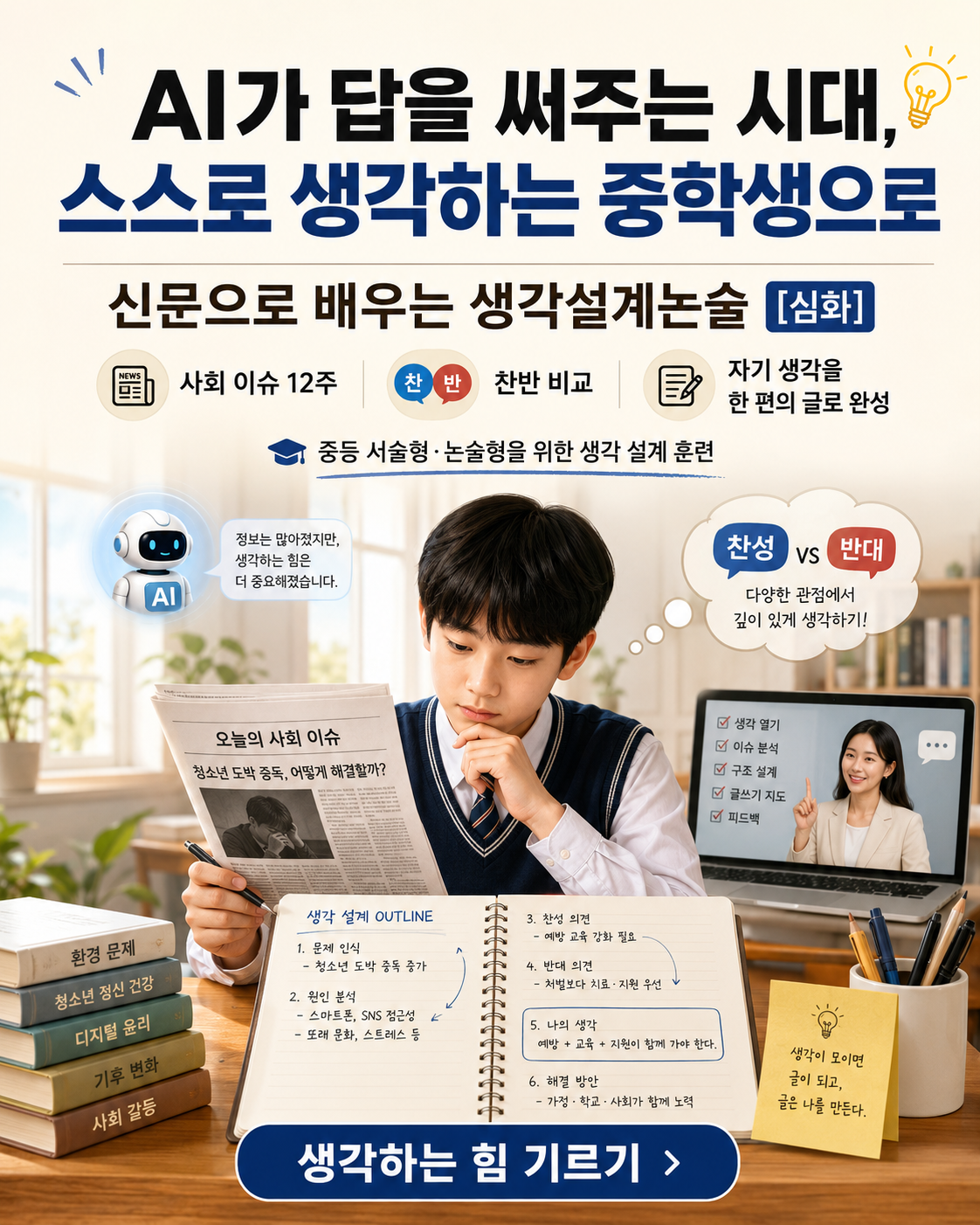
🌉 AI가 답을 써주는 시대, 스스로 생각하는 중학생으로
🔹 신문으로 배우는 생각설계논술 [심화] 12주 과정
🔹 단순 맞춤법 교정을 넘어
정보의 본질을 꿰뚫고
자기 논리를 설계하는 생존형 두뇌 훈련
🔹 시사 이슈 분석과 찬반 토론을 통해
서술형·논술형 평가에 대처하는 글쓰기 구조 정립
📌 이 수업에서 배우는 핵심 내용
이 수업은 정답을 맞히는 것보다 왜 그렇게 생각했는지
스스로 '까닭'을 찾아가며 논리적 설득력을 기르는 데 집중합니다.
신문 기사를 통한 실시간 사회 이슈 분석
이슈별 찬반 쟁점 분석 및 다각도 근거 비교
글로벌 사례 탐색을 통한 비판적 사고 확장
개요 설계 및 문장 틀을 활용한 종합 논술 작성
✍🏻 수업 완강 후 학생은 이렇게 변화합니다
비판적 정보 수용
주어진 정보를 그대로 받아들이지 않고,
날카로운 질문을 던지며 의문을 제기하는
비판적 사고가 몸에 뱁니다.
논리적 논증 글쓰기
찬반 양론의 근거를 명확하게 비교 분석하여,
자신의 주장을 뒷받침하는
단단한 논증 글을 쓸 수 있습니다.
서술형 평가 완벽 대비
수행평가나 논술형 시험지를 마주했을 때,
당황하지 않고 문장의 뼈대를 잡아
논리적으로 핵심을 전개합니다.
💡 12주 과정을 마치면 정답을 쫓는 아이가 아니라,
스스로 정답을 설계하고
논증하는 힘을 가지게 됩니다.
🎯 이런 학생에게 추천합니다
📌 안내: 원고지 칸 채우기식의 단순 받아쓰기나
맞춤법 교정만 반복하는 정형화된 수업이 아닙니다.
현실 사회 이슈를 읽고 스스로 판단하여
상대의 논리를 뒤집는
진짜 글쓰기 능력을 키우고 싶은 학생에게 적합합니다.
학교 서술형·논술형 시험 앞에서 손이 멈추는 학생
책은 읽지만 자기 생각은 잘 말하지 못하는 학생
사회 이슈에 관심은 있지만 글로 정리하기 어려운 학생
토론과 글쓰기를 제대로 훈련해 고교 진학을 준비하고 싶은 학생
📚 커리큘럼 안내 (총 12회)
회차별 프린트 학습 자료가 제공되니,
수업 전에 프린트해서 준비해주시길 바랍니다.
1회차 | SNS 금지
2회차 | AI 윤리
3회차 | 기후와 에너지
4회차 | 로봇과 일자리
5회차 | CCTV
6회차 | 딥페이크
7회차 | 유전자 복원
8회차 | 어린이 유튜버
9회차 | 화성 이주
10회차 | 시험 점수
11회차 | 패스트패션
12회차 | 표현의 자유
👩🏫 선생님 소개
우연화 선생님

수업 특징
현실 비즈니스 최전선과 고난도 채용 면접 현장에서
수만 명을 평가하고 합격시킨
실전형 안목으로 수업을 이끕니다.책상머리 이론이 아닌,
정보를 꿰뚫어 보고 상대방을 논리적으로 설득하는
실전 생존형 두뇌 훈련을 지도합니다.
학부모님께는 실전 트렌드를 반영한진로 코칭 로드맵을 선사합니다.
🔁 수업 운영 방식
1. 신문 기사 분석
그 주의 주제를 기사처럼 읽으며 큰 그림을 잡습니다.
2. 대립 근거 대조
양쪽 입장의 근거를 꼼꼼히 따라가며 비교합니다
3. 글로벌 시각 확장
해외 주요 국가 및 글로벌 사회에서는 이 문제를 어떻게 다루는지 탐색합니다.
4. 다차원 분석 질문 해결
분석·비교·추론 등 열 개의 질문에 답하 스스로 생각하는 흐름을 설계합니다.
5. 종합 논술문 작성
개요를 짜고, 문장 틀로 뼈대를 세워, 한 편의 글을 완성합니다.
Curriculum
Total 12 sessions
Session 1
SNS 금지
Session 2
AI 윤리
Session 3
기후와 에너지
Session 4
로봇과 일자리
Session 5
CCTV
Subscription Class Information
A renewal payment for the next session is automatically processed immediately after each class ends. You may unsubscribe at any time.
If a session cannot be held due to the teacher, you will be notified by email.
The charge for any session that does not take place will be processed as 0G.
Teacher Info
Auto-translated to English.
우연화
Reviews
0
Before I taught how to solve problems, I was on the side of creating them. [Biography] Current) Director of Geomdan Kium Korean Language & Essay Academy — Guidance on elementary debate/essay writing and literacy, and middle school Korean school exams Current) Exam Question Committee Member at Korea University of Technology and Education Current) Development of interview questions for large corporations and interviewer for public institutions Current) Representative of the Korea Literacy Research Institute — Development and publication of Korean language and essay textbooks for elementary and middle schools Current) Professor for the Korea Management Association's Recruitment Interview Expert Course / Professor and Public Institution Interviewer at KBS Former) Representative Professor for Civil Service Interviews at Eduwill Former) Mentor for the Foreign Service Exam Class (Level 5) at Sungkyunkwan University Lecturer at numerous universities including Sogang University, Sungkyunkwan University, Kookmin University, and Dongguk University As an exam question committee member at Korea University of Technology and Education, I create questions and identify the questions to be asked of applicants during the recruitment process for large corporations. The question creation process proceeds in this order: I determine what to verify with the question, formulate the correct answer, and finally, formulate the incorrect answer. This is the key point. Incorrect answers are not created haphazardly. To ensure that students with only a superficial understanding are bound to fall for it, sentences that are similar to the text but differ by just one word are deliberately placed there. The questions where children say, "I knew this, but I made a mistake," are exactly those designed in this way. It is not a mistake; the test creator has calculated the child's weakness in advance. I show that calculation exactly to the child. And if you start this training in middle school, it is too late. 📘 Instructional Design by Grade 🌱 Elementary Grades 3–4 — The stage where one independently identifies the important parts of a text At this stage, children cannot answer "What was the content about?" even after reading the entire text. This is because they read with the same weight from beginning to end. Therefore, we begin with the practice of marking the single most important sentence in each paragraph. Even if the sentence the child chose is incorrect, I do not point it out; instead, I have them explain why they chose that sentence. If the habit of attaching reasons to their own judgments is formed at this stage, they will not falter even when the difficulty of the passages increases in the upper grades. We also begin writing exercises where they organize their thoughts in short pieces. 🔍 Elementary Grades 5–6 — The Stage of Attaching One’s Own Opinion to What They Read Many children grasp the content but get stuck when asked, "So, what are your thoughts?" This is not because they lack thoughts, but because they have no experience in expressing their opinions by attaching supporting evidence. In debate and essay writing classes, children read the same text and express different opinions. At that time, I always ask the same thing: "Which sentence in the text made you think that?" I guide them to state their evidence rather than just their personal impressions. During this period, we broaden the range of texts they read by covering newspaper articles, practical writing, and non-fiction passages. 🧭 Middle School — The Stage of Learning the Examiner's Perspective From middle school onwards, simply understanding the text is not enough to earn a good score. A single sentence from the textbook text is scattered into five multiple-choice options on the exam paper, and even while the child remembers the original text, they cannot determine which of them conveys the same idea. Descriptive questions are even more explicit. The grading rubric includes conditions such as: ① Describe the cause of the conflict ② Find and write the evidence from the text ③ Write it in a single sentence. The child writes with great care, but if they meet only two out of three conditions, half of the points are lost. I have them write their answers with the rubric laid out first. If there are three conditions, I organize the sentences into three blocks. 🌟 The Children I Met There was a child who came home with a score of 54 in Korean. It wasn't because they didn't know the vocabulary. They narrowed down the answer choices to two, and from there, they selected without reading further. I did not tell them the correct answers for two months. For every question, I had them write, "Write down in one sentence why you chose this." Once they began to confront their own errors in their own sentences, their scores began to improve, and two months later, they rose to the 90s. There are also several children who came home with a perfect score. A perfect score is not achieved simply by knowing a lot. A perfect score is given to the child who recognizes the single question where the examiner has set a trap. I also have experience sending a child to university through an interview, even though I thought it would be difficult for them to get in based on their school grades alone. A student who used to fall behind when ranking based on grades turned the tables once they learned how to formulate their own logic into sentences. 🧭 I am the current director of a Korean Language and Essay Writing academy. However, our academy does not conduct level tests. I can tell what a student’s score is within the first hour of class. What I need to know is not the score, but the order in which the student reads the text, and that doesn't appear on the test paper. Therefore, I do not select only the high-achieving students. The average GPA for Korean grades among students who have been enrolled for over two years, having been accepted in this way, is 94 points. Rather than matching the student's level, I raise their level. I guide them not to become students who simply find the correct answer, but students who can explain why that is the correct answer.
Experience & Activities
·
CEO of Doun Co., Ltd. (Management Consulting)
·
Director of Kiwoom Korean Language and Essay Academy
·
Professor of the Korea Management Association's Recruitment Interview Expert Course
·
Main Professor, Public Institution Interviewer Course, KBS Institute of Sports and Arts
·
Representative of The Growth Speech & Interview Education (Entrance Exam Interview)
·
Former Eduwill Civil Service Interview Representative Professor
·
Former Vice Director of Kiwoom Speech & Interview Academy Gangnam Branch
·
Former Hyundai Oilbank Marketing Team
See Full Teacher Profile
Class Reviews
Growth Reviews for This Class