



- One Day
- 국어
- 글쓰기
[원데이 특강] OREO 구조 논술 : 정의란 무엇인가? 공리주의 vs 롤스
OREO 구조 논술을 미리 경험하는 원데이 특강! 공리주의 vs 롤스에 관한 수능 국어 비문학 유형의 지문을 읽고 논설문을 씁니다. 첨삭 2회 포함!
40%30,000G(US$20.70)
One Day
11-13
Max 4people
50min
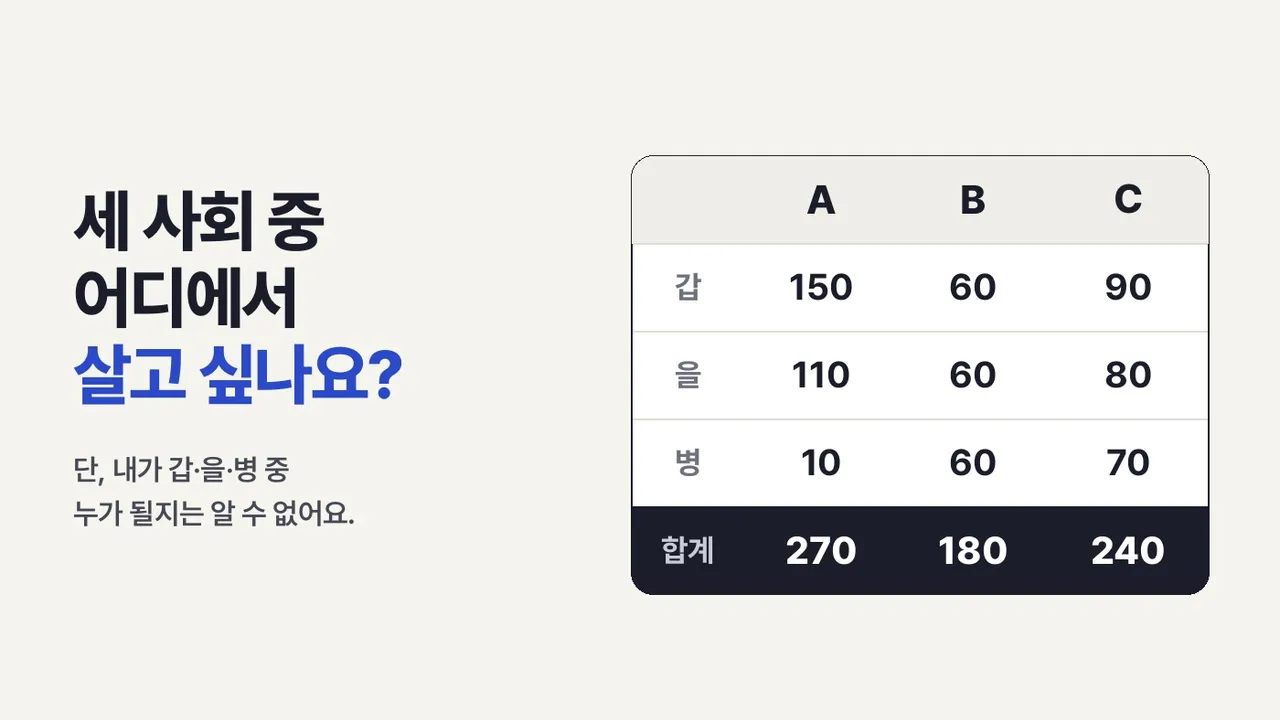
⚖️ 정의란 무엇일까?
세 개의 사회 중 하나를 골라 보세요.
A, B, C 세 사회가 있습니다.
여러분은 그중 한 곳에서 살아야 해요.
단, 그 사회에서 부자가 될지
가난한 사람이 될지는 알 수 없어요.
A 사회는 가진 것의 합이 가장 크지만
한 사람은 아주 적게 가집니다.
B 사회는 모두가 똑같이 가져요.
C 사회는 차이는 있지만
가장 적게 가진 사람도 꽤 가져요.
여러분은 어떤 사회를 고르겠어요?
이번 원데이 특강은
초등 고학년을 위한
OREO 구조 논술 정규반을
미리 경험해 보는 수업입니다.
50분 동안 정의에 대한 지문을 읽고,
친구들과 토론도 하고,
내 생각을 논리적인 구조로 정리합니다.
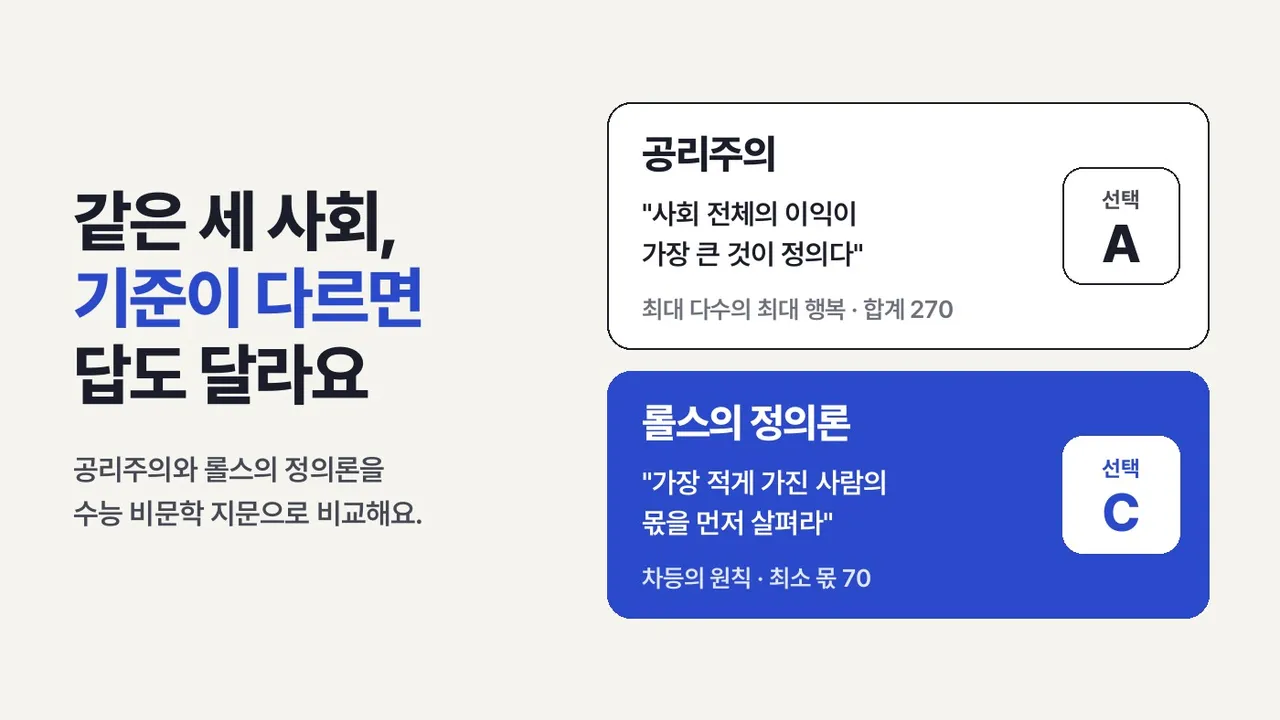
✨ 이 수업에서 만나는 두 가지 분배적 정의
✅ 공리주의
"사회 전체의 이익이 가장 큰 것이 정의다"
'최대 다수의 최대 행복'을 기준으로
가진 것의 합이 가장 큰 사회를 골라요.
✅ 롤스의 정의론
"가장 어려운 사람을 먼저 생각하라"
내가 누가 될지 모르는 '무지의 베일'을
쓰고 규칙을 정한다면,
가장 적게 가진 사람의 몫을
먼저 살피게 된다고 보았습니다.
롤스는 이를 '차등의 원칙'이라고 불렀어요.
두 관점을 비교하는 지문을
수능 국어 비문학 형식으로 읽으며
어려운 개념도 차근차근 익힙니다.
같은 세 사회를 두고도
기준에 따라 답이 달라지는 걸
직접 확인하게 될 거예요.
⏰ 수업시간은 이렇게 진행돼요
00–05분 : 내가 살고 싶은 사회 선택하기
내가 갑·을·병 중 누가 될지 모르는 상태에서 A·B·C 사회 중 하나를 고르고, 이유를 짧게 말해요.
05–20분 : 지문 읽기 & 개념 익히기
공리주의와 롤스의 정의론 지문을 함께 읽어요. 공정·무지의 베일·차등의 원칙·공리주의를 한자 뜻과 함께 정리하고, 각 관점에서 어떤 사회를 골라야 하는지 확인해요.
20–28분 : 4문장 쓰기
어떤 사회를 선택할지 주장–이유–근거–결론 4문장으로 써요.
28–38분 : 발표 & 반론과 재반론
친구들의 선택과 근거를 듣고 기록해요. 나와 다른 생각에 반론을 떠올리고, 재반론으로 내 입장을 지켜요.
38–46분 : 나의 최종 논증
오늘 쓴 문장을 모아 주장–이유–근거–반론–재반론–결론 6문장으로 정리해요.
46–50분 : 피드백 & 정리
선생님이 바로 피드백을 주고, 과제에서 고칠 한 가지 포인트를 짚어줘요.
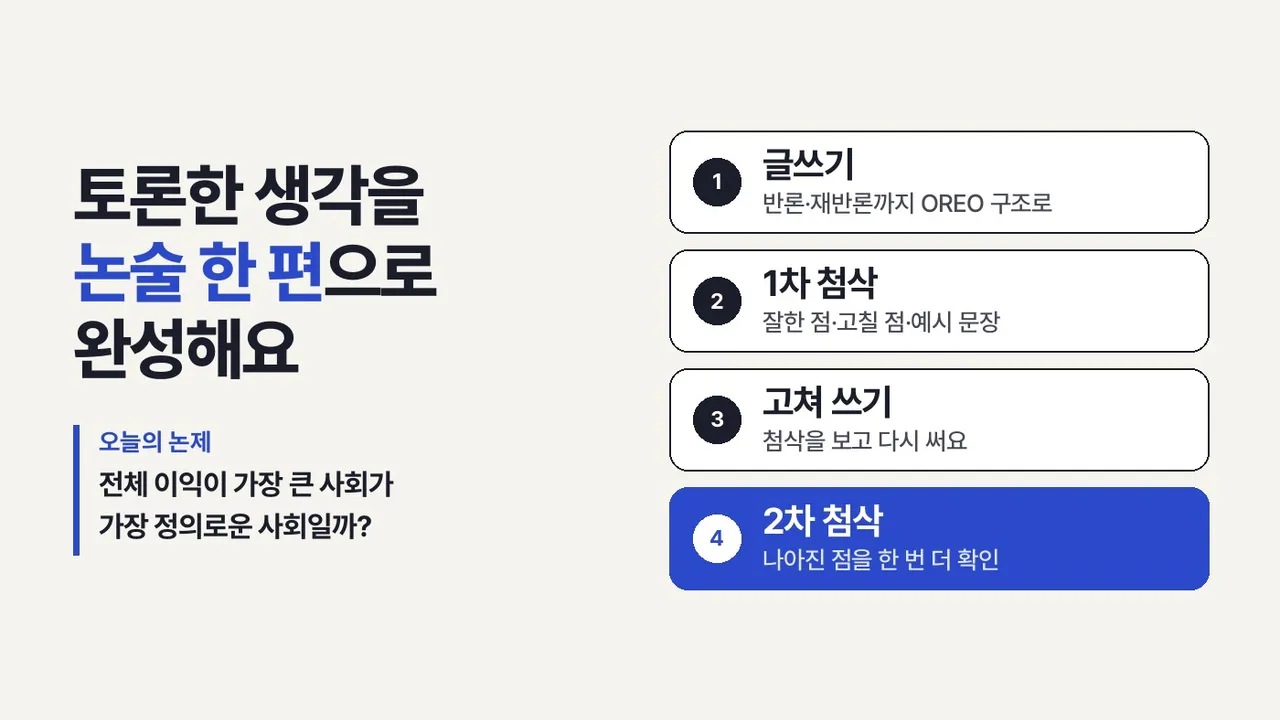
✏️ 수업 후에는 이렇게 이어져요
수업에서 세운 OREO 뼈대로
반론과 반박까지 담은
논술형 글 한 편을 씁니다.
선생님이 글을 꼼꼼히 읽고
잘한 점, 가장 먼저 고칠 점,
고쳐 쓴 예시 문장까지
1차 첨삭지로 돌려드립니다.
첨삭을 바탕으로 글을 고쳐 쓰면
2차 첨삭으로 한 번 더 살펴보며
처음 글보다 얼마나 좋아졌는지
확인해 드립니다.
글쓰기 → 1차 첨삭 → 고쳐 쓰기 → 2차 첨삭
✅ 이런 학생에게 추천해요
정답이 없는 질문을 두고 깊이 생각해 보고 싶은 학생
교과서에서 배운 개념이 포함된 글쓰기 경험이 부족한 학생
수능 국어와 통합사회에 나오는 개념을 초등 눈높이에서 미리 만나보고 싶은 학생
이유와 반박까지 쓰는 논술 훈련을 해보고 싶은 학생
OREO 논술 수업을 미리 경험해 보고 싶은 학생
🎓 이런 선생님이 함께해요
대치동에서 학생들을 직접 지도한 경험으로 수업을 설계했습니다.
독서 토론 논술을 바탕으로 논리적으로 말하고 쓰도록 지도해 왔습니다.
수업을 들은 학생들이 학교 글쓰기 대회에서 대상을 받은 경험이 많습니다.

💬 정답보다 중요한 건, 나의 이유
A, B, C 중 정답인 사회는 없어요.
하지만 "왜 그 사회를 골랐는지"를
근거를 들어 말하고 쓸 수 있는 아이는
어떤 질문 앞에서도 흔들리지 않습니다.
이 수업을 마치면
공리주의와 롤스라는 두 개의 눈으로
세상을 바라보는 법을 배우고,
두 번의 첨삭으로 다듬은
나만의 논술 한 편이 남습니다.
원데이 특강이 마음에 들었다면,
매주 하나의 개념으로 이어지는
OREO 구조 논술 정규반에서 만나요!
Great for These Kids
초등 5~6학년 학생
OREO 논술 정규반을 듣기 전에 수업을 미리 경험해 보고 싶은 학생
정답이 없는 질문을 두고 근거를 들어 생각하는 힘을 키우고 싶은 학생
논리적인 구조에 맞춰서 글을 쓰고 싶은 학생
수능 국어 및 통합사회 서논술형을 대비하고 싶은 학생
특목고·영재고·자사고 진학을 목표로 면접과 논리적 사고를 미리 준비하고 싶은 학생
의대 MMI(다중 미니 면접)의 윤리 딜레마 질문에 일찍부터 대비하고 싶은 학생
초등 3학년 이하의 학생
One Day Class Information
If you cancel within 48 hours of the scheduled class, a cancellation fee will apply based on the timing of cancellation.
If you cancel more than 48 hours before the scheduled class, a full refund will be issued with no cancellation fee.
To reschedule, please cancel and rebook.
If the teacher cancels the class, you will receive a full refund and any coupons used will be restored.
Teacher Info
Auto-translated to English.
"Korean language proficiency begins with concepts, not problem-solving." Hello. I am Seo Ji-hoon, an instructor in reading, essay writing, and logical writing. I believe that true Korean language proficiency is not built simply by children reading many books and passages and solving many problems. The power to understand text begins with grasping the concepts contained within it. For instance, if you accurately know concepts such as "fairness," "opportunity cost," "causation," "perspective," "evidence," and "correlation," you can identify important content and connect them even in social studies, science, or philosophy passages you encounter for the first time. Conversely, if you lack a solid understanding of concepts, you will struggle when encountering new texts, even if you read passages multiple times and solve many problems. Therefore, starting from the 5th and 6th grades of elementary school, I design classes where students systematically learn core concepts from various fields—including humanities, social sciences, science, and technology—and apply those concepts to actual passages to read, think, and express themselves. 📌 Characteristics of My Class ① Learning core concepts from diverse fields. We do not stop at merely understanding the content of the text; instead, we first examine the core concepts necessary for comprehending the text. ② We study in the order of Background Knowledge → Concept Understanding → Reading the Passage → Thinking → Essay Writing. During the 50-minute class, students apply the concepts learned to actual passages, answer questions, and organize their thoughts along with supporting evidence. ③ We place great importance on "why you thought that way." What is important in essay writing is not using many difficult words. You must clearly articulate your argument, identify and connect evidence within the passage, and be able to compare your ideas with others. ④ We manage the concepts learned in class cumulatively. We record cumulatively which concepts the student has newly learned and which concepts they understand well. This allows us to verify "how their thinking skills are growing," rather than simply "how many points they received on this exam." ⑤ After class, we refine the writing through essay corrections. Students complete the content they thought about in class into writing and check their answers using our in-house developed essay evaluation system. We developed this system by reverse-engineering the Korea Institute of Curriculum and Evaluation's (KICE) intentions for the CSAT. Rather than simply providing a score, we revise the writing by checking what evidence was used in the passage, whether the argument connects well with the evidence, and what could be improved. --- 📚 Why Start with 5th and 6th Grades? Upper elementary grades are the time to move beyond simple reading comprehension and transition to a learning process of 'reading → thinking → finding evidence → expressing one's own thoughts.' In particular, as students advance to middle and high school, the ability to read long passages, analyze data, and explain one's own judgments with supporting evidence becomes increasingly important across various subjects such as social studies, science, and Korean language. Rather than engaging in advanced learning methods that force elementary students to solve difficult CSAT problems, it is more important to learn in advance the concepts and reading methods that form the foundation of the thinking required for the CSAT. Even elementary students can learn concepts such as 'correlation and causation,' 'equality and equity,' 'argument and evidence,' and 'perspective and prejudice' at their own level. By repeatedly applying these concepts to various passages, you will develop a habit of thinking, "What is this about?" when encountering a new text, rather than simply stopping at "What is this about?" --- 🎯 The Class I Want to Create I do not want to make this class a mere Korean language problem-solving session. Nor is it a class where students simply read a book and write a book report. It is a class that repeats the process of learning a new concept → discovering that concept in various texts → comparing different perspectives → finding evidence to think → and expressing it in one's own words. I will help students so that when they encounter unfamiliar passages in middle and high school, they do not panic, but can confidently think, "I know this concept." "I can find the argument and evidence in this text." "I can explain the difference between the two perspectives." "I can state my thoughts along with evidence." Skills for the CSAT begin with how accurately one holds concepts and thought structures in their mind. We will work together to build the power to read, think, and express, starting step-by-step from the 5th and 6th grades of elementary school and continuing through middle and high school.
Experience & Activities
·
2 years as the lead instructor for Reading and Essay Writing at Olgeum Korean Language Academy in Daechi-dong
·
5 years as the head essay instructor at Ganeung Segye Academy in Myeongil-dong
·
4 years of operating an elementary school reading and writing book club
·
Books: The Last Enter Key, The Architect of Reason
See Full Teacher Profile
Class Reviews
Growth Reviews for This Class