



46 people recently viewed this class
 46 people recently viewed this class
- Subscription
- 국어
- 글쓰기
[소수 정예] OREO 구조 논술 2 : 수능 국어 통합사회 수행평가 서논술형 대비
매주 수능 국어·통합사회 지문을 읽고 토론한 뒤, 반론과 재반론까지 담은 OREO 심화 논술을 씁니다. 첨삭 2회로 수행평가와 수능 서논술형까지 대비해요.
40%30,000G(US$20.70)
Subscription
12-13
Max 4people
50min
📘 중학교 서논술형 평가부터
수능 국어 통합사회까지, 지금 준비해요
중학교에 가면 시험이 달라집니다.
수행평가에서는 논술형 글을 쓰고,
서술형 문항은 근거까지 요구하죠.
개념은 아는데 글로 옮기지 못하나요?
주장은 있는데 근거가 약하다는
말을 자주 듣나요?
반론을 생각하지 못해
글이 한쪽으로만 흐르나요?
2028학년도 수능부터
통합사회가 시험 과목이 됩니다.
국가교육위원회는 수능에
서논술형 도입도 검토하고 있습니다.
이 수업은 고등학교 통합사회의
핵심 개념을 아이들의 눈높이로 읽고,
OREO 구조로 논리적인 글을 씁니다.
그리고 선생님 첨삭을 두 번 받아
한 편의 논설문을 끝까지 완성합니다.

✨ 이 수업은 이런 점이 달라요
✅ 고등학교 통합사회 순서를 따라가요
통합사회 교과 단원 순서대로
1년 동안 약 40개의 핵심 개념을
하나씩 깊이 있게 다룹니다.
✅ 중등 수준으로 더 깊이 읽어요
같은 개념도 더 긴 지문,
더 날카로운 질문으로 다룹니다.
두 관점을 비교하고 평가하며
수능 비문학을 읽는 힘을 길러요.
✅ 서론부터 결론까지, 논설문 한 편
주장, 이유와 근거, 반론과 반박,
결론까지 갖춘 논설문을 씁니다.
중학교 수행평가 논술형 과제에
그대로 쓸 수 있는 힘이에요.
✅ 수능형 지문으로 읽어요
지문은 수능 비문학 유형의 글입니다.
두 관점을 비교하는 글을 읽으며
긴 글을 구조로 읽는 힘을 길러요.
✅ 쓰고, 고치고, 다시 써요
글쓰기 → 1차 첨삭 → 고쳐 쓰기
→ 2차 첨삭까지 이어집니다.
한 번 쓰고 끝나는 글이 아니라
고쳐 쓰며 단단해지는 글이에요.
✅ 한 수업에 한 주제가 끝나요
매 수업이 하나의 주제로 완결돼요.
언제 시작해도 바로 따라올 수 있어요.
⏰ 수업은 이렇게 진행돼요
매주 50분, 소수 정예로 진행합니다.
00-05분 오늘의 개념 만나기
상황 A·B·C 중 하나를 고르고
그 이유를 말해 봅니다.
05-10분 생각 열기
일상과 사회 문제 속에서
오늘의 개념을 찾아봅니다.
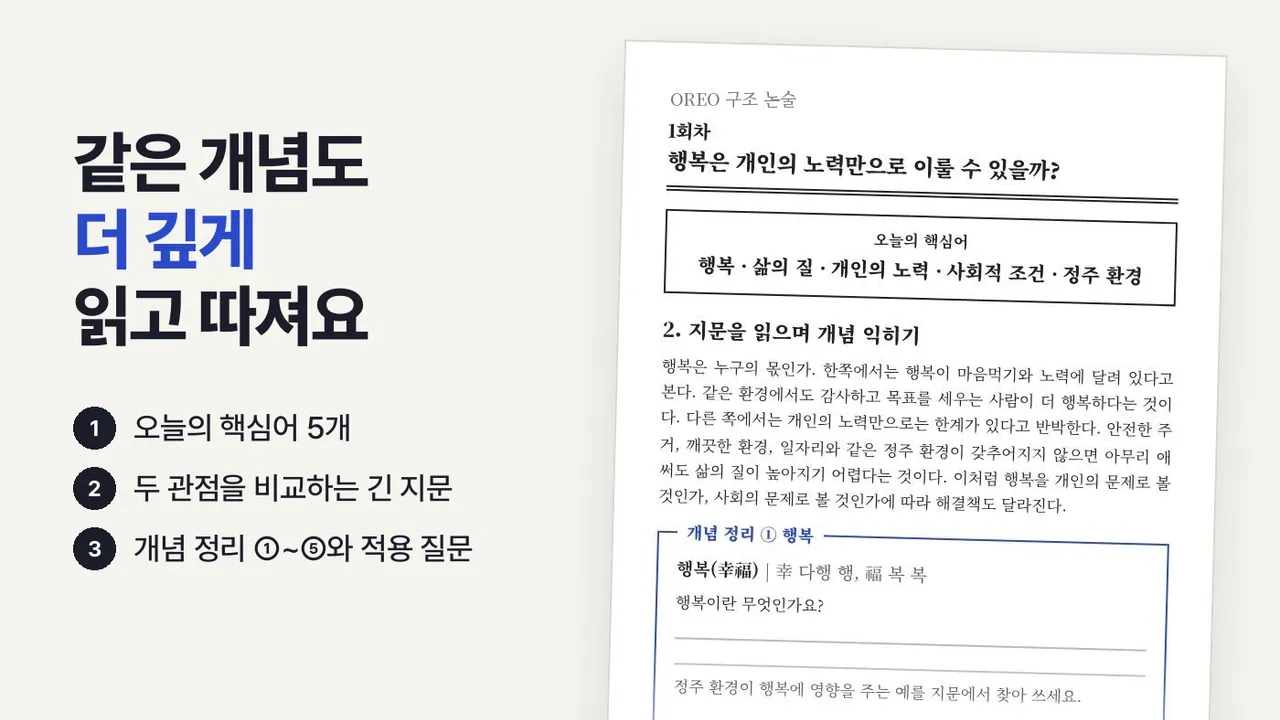
10-30분 지문 읽기 & 개념 정리
수능 비문학 형식의 지문을 읽고
핵심어 5개를 정의하고 적용해요.
30-45분 토론 & 나의 주장 만들기
핵심 질문을 두고 찬반을 나누고
반론까지 예상해 봅니다.
45-50분 생각 정리 & 피드백
오늘의 주장을 정리하고
선생님이 바로 짚어 드려요.
✏️ 수업 후에는 이렇게 이어져요
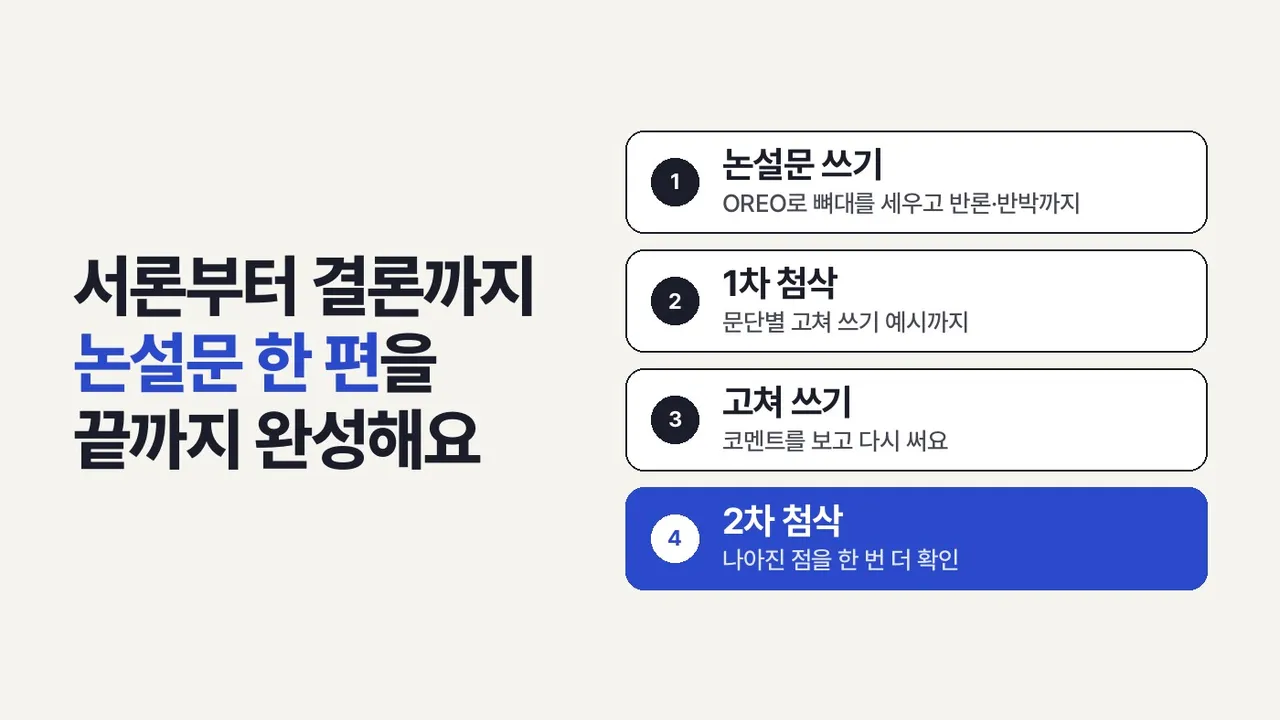
1단계 OREO로 생각 정리
Opinion(주장) - Reason(이유)
- Evidence(근거) - Opinion(재주장)
하버드대학교 논술용 논리 구조로
글의 뼈대를 세워요.
2단계 논설문 쓰기
서론, 이유 문단, 반론과 반박,
결론까지 한 편의 글을 씁니다.
오늘 배운 핵심어를 꼭 넣어요.
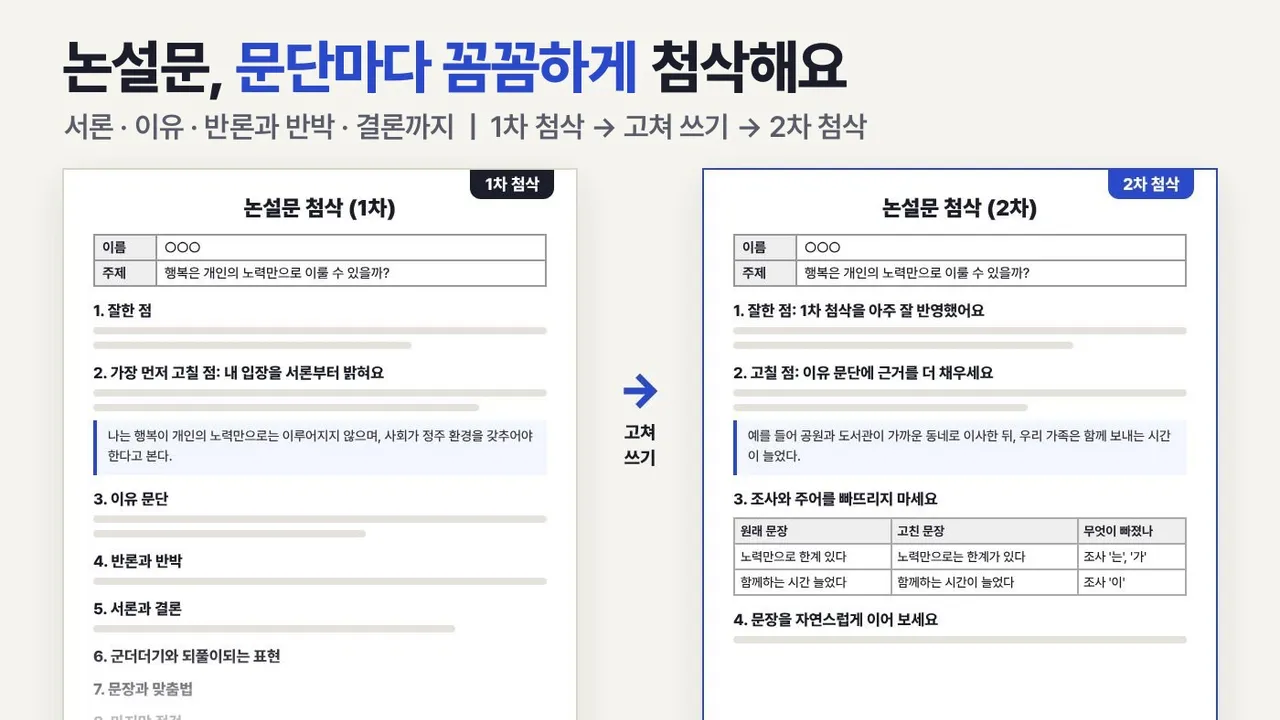
3단계 1차 첨삭
잘한 점, 가장 먼저 고칠 점부터
문단별 고쳐 쓰기 예시,
군더더기와 맞춤법까지
꼼꼼한 첨삭지로 돌려드립니다.
4단계 고쳐 쓰기
첨삭을 보고 글을 다시 씁니다.
5단계 2차 첨삭
고친 글을 한 번 더 봐 드려요.
무엇이 나아졌는지, 남은 한두 가지가
무엇인지 짚어 드립니다.
📚 1년 커리큘럼 미리 보기
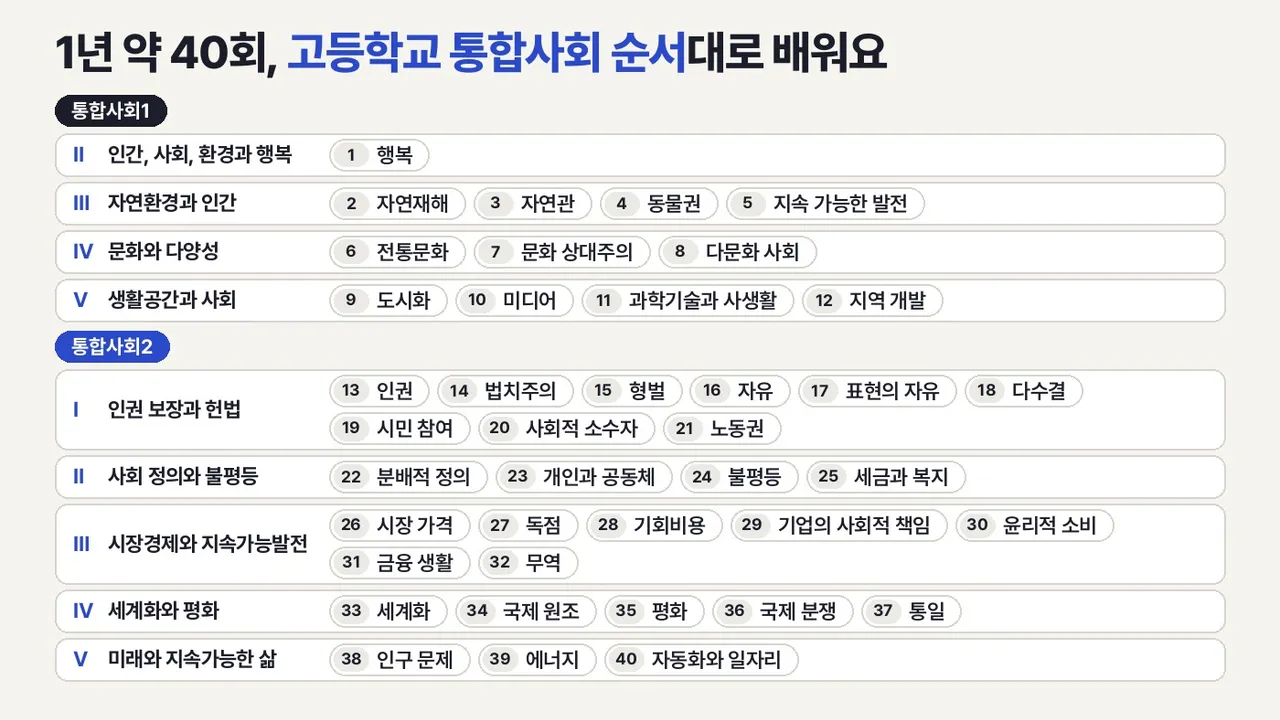
통합사회1
행복 / 자연 / 자연관 / 동물권
지속 가능한 발전 / 전통문화
문화 상대주의 / 다문화 사회
도시화 / 미디어 / 과학기술과 사생활
지역 개발
통합사회2
인권 / 법치주의 / 형벌 / 자유
표현의 자유 / 다수결 / 시민 참여
사회적 소수자 / 노동권
분배적 정의 / 개인과 공동체
불평등 / 세금과 복지
시장 가격 / 독점 / 기회비용
기업의 사회적 책임 / 윤리적 소비
금융 생활 / 무역
세계화 / 국제 원조 / 평화
국제 분쟁 / 통일
인구 문제 / 에너지 / 자동화와 일자리
📈 수업 전·후, 이렇게 달라져요
수업 전에는 주장만 있고
근거가 비어 있어요.
수업 후에는 이유마다 근거를 붙여
문단을 스스로 완성합니다.
수업 전에는 내 생각만 씁니다.
수업 후에는 반론을 먼저 떠올리고
그에 답하는 글을 씁니다.
수업 전에는 개념어를 외웁니다.
수업 후에는 개념을 사회 문제에
적용해 내 주장의 근거로 씁니다.
수업 전에는 서술형 칸을 채우기 바빠요.
수업 후에는 서론부터 결론까지
흐름이 있는 글을 씁니다.
✅ 이런 학생에게 추천해요
· 중학교 수행평가 논술형 과제를 미리 준비하고 싶은 학생
· 주장은 있는데 근거와 반박이 약하다는 말을 듣는 학생
· 수능 국어 비문학과 통합사회를 일찍부터 준비하고 싶은 학생
· 한 편의 논설문을 끝까지 완성해 본 경험이 적은 학생
🎓 이런 선생님이 함께해요
· 대치동에서 학생들을 직접 지도한 경험으로 수업을 설계했습니다.
· 학원 강사와 운영 경험으로 다양한 학생과 학부모의 고민을 가까이에서 보아 왔습니다.
· 독서 토론 논술을 바탕으로 논리적으로 말하고 쓰도록 지도해 왔습니다.
· 수업을 들은 학생들이 학교 글쓰기 대회에서 대상을 받은 경험이 많습니다.
💬 근거 있는 글이 점수가 됩니다
중학교부터는 "내 생각"만으로
점수가 나오지 않습니다.
왜 그렇게 생각하는지,
반대 의견에는 어떻게 답하는지
글로 보여 줘야 해요.
이 수업에서는 매주 하나의 개념을
읽고, 토론하고, 쓰고, 고쳐 씁니다.
한 해가 지나면 서론부터 결론까지
흔들리지 않는 글이 남습니다.
중학교 서논술형 평가부터
수능 통합사회까지,
지금부터 함께 준비해요!
Curriculum
Session 1
행복 : 행복은 개인의 노력만으로 이룰 수 있을까?
• 핵심 개념: 행복 · 삶의 질 · 개인의 노력 · 사회적 조건 · 정주 환경 • 통합사회 연계: 행복한 삶을 실현하기 위한 조건
Session 2
자연재해 : 재난 피해를 줄이는 것은 국가의 책임일까?
• 핵심 개념: 자연재해 · 안전권 · 재난 대비 · 인재(人災) · 국가의 책임 • 통합사회 연계: 자연환경과 인간 생활
Session 3
자연관 : 인간은 자연을 마음대로 이용할 권리가 있을까?
• 핵심 개념: 자연관 · 인간 중심주의 · 생태 중심주의 · 도구적 가치 · 내재적 가치 • 통합사회 연계: 인간과 자연의 관계
Session 4
동물권 : 동물에게도 권리가 있다고 할 수 있을까?
• 핵심 개념: 동물권 · 생명 존중 · 동물 복지 · 도덕적 고려 대상 · 종 차별주의 • 통합사회 연계: 인간과 자연의 관계
Session 5
지속 가능한 발전 : 경제 성장과 환경 보호, 무엇이 먼저일까?
• 핵심 개념: 지속 가능한 발전 · 미래 세대 · 기후 변화 · 탄소 중립 · 환경 정의 • 통합사회 연계: 환경 문제 해결을 위한 다양한 노력
Great for These Kids
중학교 수행평가 논술형 과제를 미리 준비하고 싶은 학생
비문학 지문을 읽어도 핵심 내용과 관점을 놓치는 학생
주장은 있는데 근거와 반박이 약하다는 말을 듣는 학생
논설문을 쓰다 중간에 막혀 끝까지 완성하지 못하는 학생
수능 국어 비문학과 통합사회의 배경지식을 미리 쌓고 싶은 학생
초등학교 4학년 이하 학생
Subscription Class Information
A renewal payment for the next session is automatically processed immediately after each class ends. You may unsubscribe at any time.
If a session cannot be held due to the teacher, you will be notified by email.
The charge for any session that does not take place will be processed as 0G.
Teacher Info
Auto-translated to English.
"Korean language proficiency begins with concepts, not problem-solving." Hello. I am Seo Ji-hoon, an instructor in reading, essay writing, and logical writing. I believe that true Korean language proficiency is not built simply by children reading many books and passages and solving many problems. The power to understand text begins with grasping the concepts contained within it. For instance, if you accurately know concepts such as "fairness," "opportunity cost," "causation," "perspective," "evidence," and "correlation," you can identify important content and connect them even in social studies, science, or philosophy passages you encounter for the first time. Conversely, if you lack a solid understanding of concepts, you will struggle when encountering new texts, even if you read passages multiple times and solve many problems. Therefore, starting from the 5th and 6th grades of elementary school, I design classes where students systematically learn core concepts from various fields—including humanities, social sciences, science, and technology—and apply those concepts to actual passages to read, think, and express themselves. 📌 Characteristics of My Class ① Learning core concepts from diverse fields. We do not stop at merely understanding the content of the text; instead, we first examine the core concepts necessary for comprehending the text. ② We study in the order of Background Knowledge → Concept Understanding → Reading the Passage → Thinking → Essay Writing. During the 50-minute class, students apply the concepts learned to actual passages, answer questions, and organize their thoughts along with supporting evidence. ③ We place great importance on "why you thought that way." What is important in essay writing is not using many difficult words. You must clearly articulate your argument, identify and connect evidence within the passage, and be able to compare your ideas with others. ④ We manage the concepts learned in class cumulatively. We record cumulatively which concepts the student has newly learned and which concepts they understand well. This allows us to verify "how their thinking skills are growing," rather than simply "how many points they received on this exam." ⑤ After class, we refine the writing through essay corrections. Students complete the content they thought about in class into writing and check their answers using our in-house developed essay evaluation system. We developed this system by reverse-engineering the Korea Institute of Curriculum and Evaluation's (KICE) intentions for the CSAT. Rather than simply providing a score, we revise the writing by checking what evidence was used in the passage, whether the argument connects well with the evidence, and what could be improved. --- 📚 Why Start with 5th and 6th Grades? Upper elementary grades are the time to move beyond simple reading comprehension and transition to a learning process of 'reading → thinking → finding evidence → expressing one's own thoughts.' In particular, as students advance to middle and high school, the ability to read long passages, analyze data, and explain one's own judgments with supporting evidence becomes increasingly important across various subjects such as social studies, science, and Korean language. Rather than engaging in advanced learning methods that force elementary students to solve difficult CSAT problems, it is more important to learn in advance the concepts and reading methods that form the foundation of the thinking required for the CSAT. Even elementary students can learn concepts such as 'correlation and causation,' 'equality and equity,' 'argument and evidence,' and 'perspective and prejudice' at their own level. By repeatedly applying these concepts to various passages, you will develop a habit of thinking, "What is this about?" when encountering a new text, rather than simply stopping at "What is this about?" --- 🎯 The Class I Want to Create I do not want to make this class a mere Korean language problem-solving session. Nor is it a class where students simply read a book and write a book report. It is a class that repeats the process of learning a new concept → discovering that concept in various texts → comparing different perspectives → finding evidence to think → and expressing it in one's own words. I will help students so that when they encounter unfamiliar passages in middle and high school, they do not panic, but can confidently think, "I know this concept." "I can find the argument and evidence in this text." "I can explain the difference between the two perspectives." "I can state my thoughts along with evidence." Skills for the CSAT begin with how accurately one holds concepts and thought structures in their mind. We will work together to build the power to read, think, and express, starting step-by-step from the 5th and 6th grades of elementary school and continuing through middle and high school.
Experience & Activities
·
2 years as the lead instructor for Reading and Essay Writing at Olgeum Korean Language Academy in Daechi-dong
·
5 years as the head essay instructor at Ganeung Segye Academy in Myeongil-dong
·
4 years of operating an elementary school reading and writing book club
·
Books: The Last Enter Key, The Architect of Reason
See Full Teacher Profile
Class Reviews
Growth Reviews for This Class