



AI 시대, 4주 논술 훈련! 질문하고 생각하고 근거로 쓰기
0
(0)
“AI도 생각할까?”, “AI가 만든 그림도 예술일까?” 같은 질문을 지문으로 탐구하고, 주장·이유·근거·결론을 세워 4주 동안 총 4편의 논술을 완성하는 초5~6 논리적 글쓰기 수업!
50%30,000G(US$20.70)
Per Session
Subscription
12-13
Max 8people
50min
서지훈
Reviews
1
🤖 AI는 매일 쓰는데,
“왜 그렇게 생각해?”에는 답할 수 있나요?
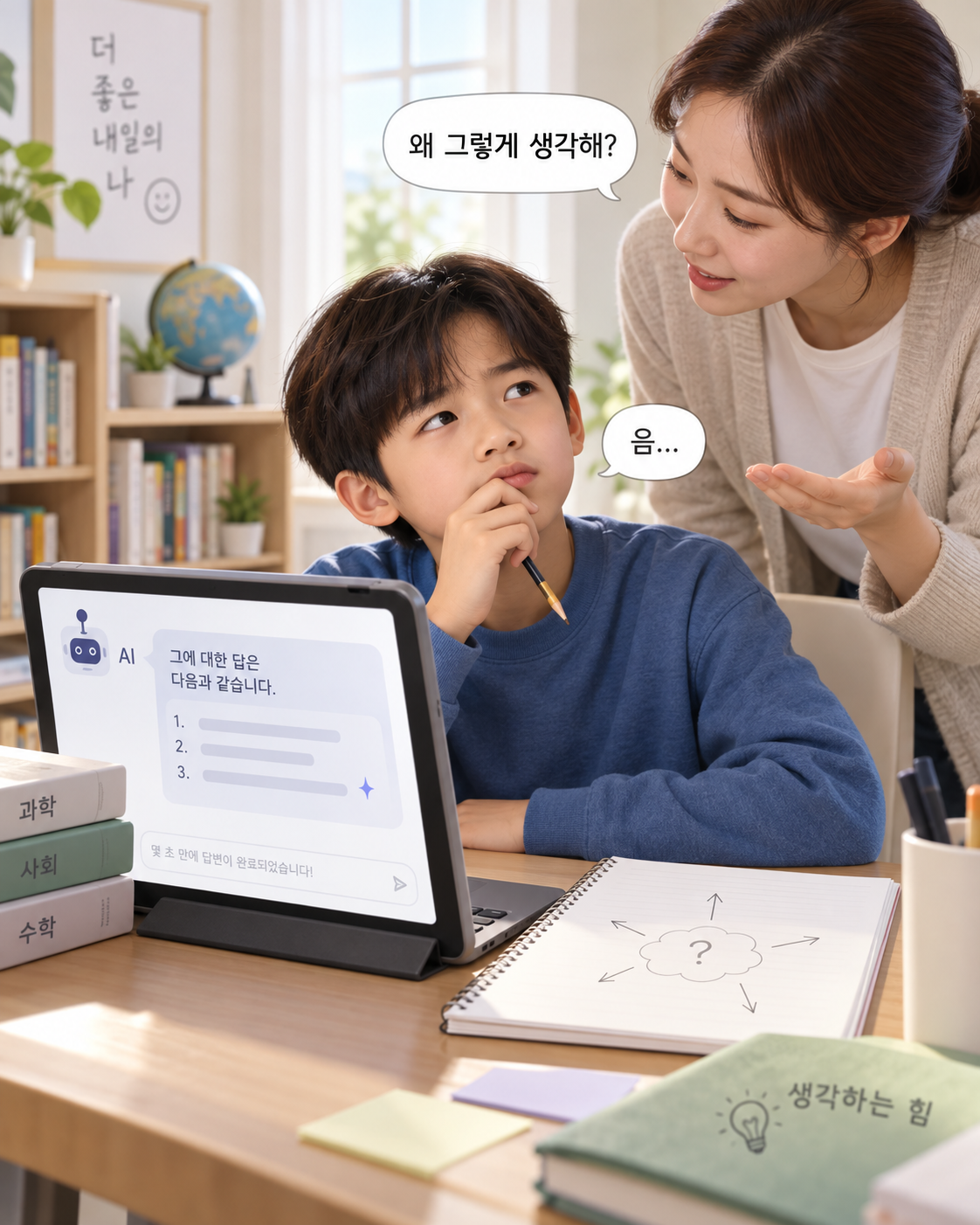
AI가 답을 알려주는 건 익숙하지만
정작 내 생각을 물으면
"그냥 그런 것 같아요."에서
멈추는 아이가 있습니다.
이번 4주 수업에서는
AI를 둘러싼 질문을 읽고 생각하며
주장 → 이유 → 근거 → 결론
순서로 한 편의 글을 직접 완성합니다.
AI에게 답을 얻는 데서 한 걸음 더,
내 생각을 근거로 써봐요.
🔎 AI 시대에는
정답보다 ‘왜?’를 설명하는 연습도 필요해요

AI에게 질문하면
몇 초 만에 그럴듯한 답을 받을 수 있습니다.
하지만 그 답이 맞는지 판단하고
나는 어떤 입장인지,
무엇을 근거로 그렇게 생각하는지는
스스로 정해야 합니다.
그래서 이 수업은
AI 사용법을 배우는 대신
질문하고 → 판단하고 →
근거를 들어 쓰는 연습 을 합니다.
그래서 준비했습니다 🙌
체험에서 4주 논술로 이어가요
체험수업에서
하나의 개념을 읽고
짧게 생각을 써봤다면,
이번 4주 수업에서는
매주 새로운 AI 질문을 만나
지문 읽기부터
한 편의 논술 완성까지 이어갑니다.
💡 논리적 글쓰기를
어떻게 연습할까요?
POINT 01. 질문에서 시작해요
AI도 생각할까?처럼
정답이 하나가 아닌 질문에서
내 입장을 직접 정합니다.
POINT 02. 근거를 갖고 써요
생각나는 대로 쓰지 않고
주장 → 이유 → 근거 → 결론으로
논리를 세웁니다.
POINT 03. 논술 지도 7년
대치동·명일동에서
7년간 논술을 지도한 서지훈 선생님과
읽기·토론·글쓰기를 연결합니다.
✍️ 4주 동안
AI 질문으로 4편의 논술을 써봐요

1주차|🤖 AI도 생각할까?
인공지능·데이터·학습 개념을 읽고
AI의 ‘생각’에 대한 내 입장을 써봅니다.
2주차|👤 AI 시대, 사람의 역할은?
자동화와 일자리 변화를 살펴보고
사람에게 필요한 능력을 생각해봅니다.
3주차|🎨 AI 그림도 예술일까?
생성형 AI·창작·창의성을 알아보고
AI 작품을 예술이라 볼 수 있을지 써봅니다.
4주차|⚖️ AI의 판단을 믿어도 될까?
알고리즘·편향·책임을 살펴보고
AI 판단의 책임에 대한 글을 완성합니다.
⏱️ 매주 50분은
읽고, 토론하고, 써봐요
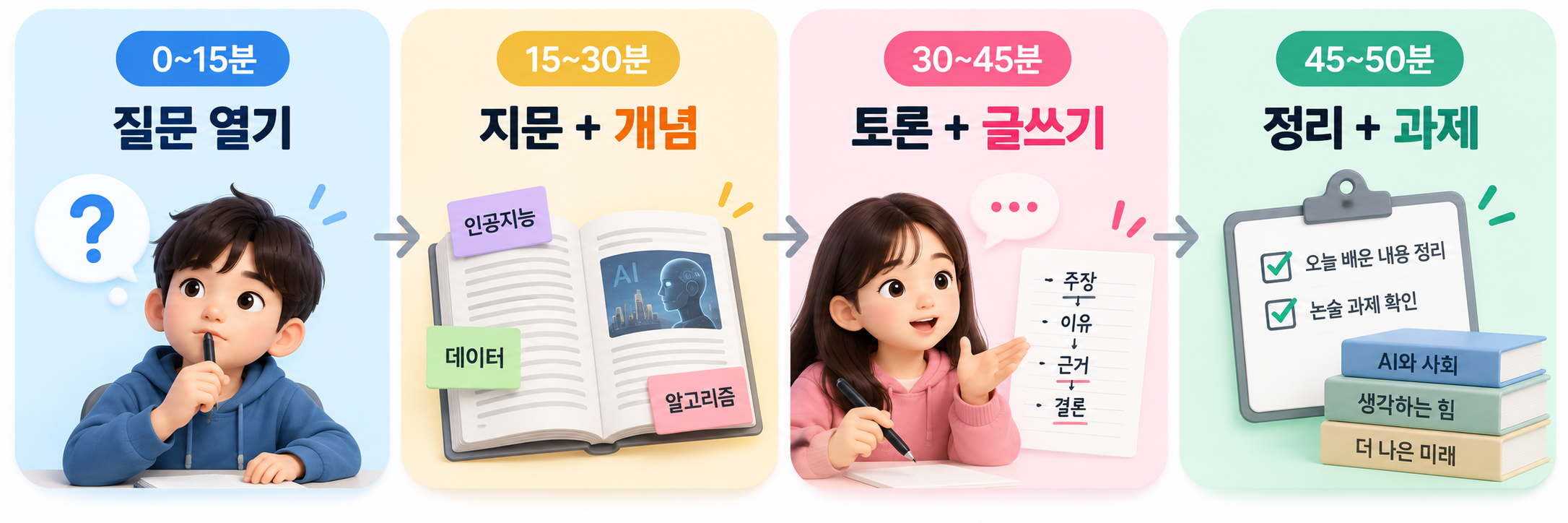
0~15분|💭 질문 열기
오늘의 질문과 관련된
배경지식·핵심 어휘를 살펴봅니다.
15~30분|📖 지문 + 개념
지문을 읽고
오늘의 핵심 개념을 정리합니다.
30~45분|✍️ 토론 + 글쓰기
내 입장을 정하고
주장·이유·근거·결론으로 써봅니다.
45~50분|✅ 정리 + 과제
오늘의 개념을 정리하고
수업 후 논술 과제를 확인합니다.
🙋 이런 초5·6에게 추천해요
01. AI·로봇·미래 기술에
관심이 많은 아이
02. 자기 생각은 있지만
글로 논리 있게 정리하기 어려운 아이
03. “왜?”라고 물으면
근거를 붙여 설명하기 어려운 아이
04. 정답이 없는 낯선 질문에도
스스로 생각해보고 싶은 아이
05. 아이가 AI 시대에
생각하는 힘을 키우고 있는지 궁금한 부모님
✨ 2개 이상 해당된다면
AI에게 답을 묻기 전에,
내 생각부터 만들어보는 연습을 시작해보세요.
🌱 4주 동안
생각을 글로 만드는 방법이 달라져요
01
Before
AI를 신기해하지만
그 원리는 깊게 생각하지 않아요.
After
“AI도 생각할까?”처럼
스스로 질문을 던져봅니다.
02
Before
내 생각은 있지만
글로 정리하면 두서없어요.
After
주장 → 이유 → 근거 → 결론
순서로 정리해봅니다.
03
Before
익숙한 주제에서는 말하지만
낯선 질문에서는 막혀요.
After
지문과 개념을 바탕으로
내 입장을 세워봅니다.
04
Before
짧은 답만 쓰고
한 편의 글로 이어가기 어려워요.
After
매주 한 가지 질문으로
완결된 논술 한 편에 도전합니다.
05
Before
아이의 생각이 어떻게 자라는지
확인하기 어려워요.
After
아이의 글과 피드백을 통해
생각의 과정을 확인할 수 있습니다.
✍️ 매주 수업 후에도
논술 한 편을 더 다듬어요
수업에서 만든 생각을 바탕으로
논술 과제를 완성해 제출하면
서지훈 선생님이 직접 글을 확인하고
피드백을 제공합니다.
4주 동안 매주 한 가지 AI 질문을
글로 끝까지 정리해보는 경험을 쌓습니다.
👨🏫 왜 서지훈 선생님일까요?
근거를 갖고 쓰게 하는 서지훈 선생님
대치동·명일동 논술 지도 7년
초등 고학년 독서·논술 지도
대치동 옳음국어학원 독서논술 대표 강사 2년
명일동 가능세계학원 논술 대표 강사 5년
초등 독서논술 북클럽 운영 4년
현재 수능 서논술형 AI 평가 시스템 연구
어려운 표현을 많이 쓰게 하기보다
질문 → 개념 → 근거 →
자기 생각 을 연결해
스스로 설명할 수 있는 글을 쓰도록 지도합니다.
❓ 자주 묻는 질문
Q. 전 과정 온라인으로 진행되나요?
네. 실시간 온라인 수업으로 진행됩니다.
Q. 다시보기는 제공되나요?
네, 다시보기는 일주일간 제공됩니다.
Q. 준비물은 무엇인가요?
필기구와 사전 제공되는 수업 자료 출력본을 준비해주세요.
Curriculum
Total 4 sessions
Session 1
AI는 정말 생각할까?
인공지능, 데이터, 학습 개념을 지문으로 배우고, AI가 사람처럼 대답한다면 정말 '생각'한다고 할 수 있는지 자신의 입장을 담은 논술을 완성합니다.
Session 2
AI가 사람보다 일을 잘한다면 사람은 무엇을 해야 할까?
자동화, 일자리, 인간의 역할 개념을 지문으로 배우고, AI 시대에 인간에게 필요한 능력은 무엇인지 논술로 정리합니다.
Session 3
AI가 만든 그림도 예술일까?
생성형 AI, 창작, 창의성 개념을 지문으로 배우고, AI 작품을 예술 작품이라 부를 수 있는지에 대한 논술을 완성합니다.
Session 4
AI의 판단을 믿어도 될까?
알고리즘, 편향, 판단, 책임 개념을 지문으로 배우고, 지금까지 배운 내용을 종합해 AI 판단의 책임은 누구에게 있는지 완결된 논술로 정리합니다.
Great for These Kids
AI, 로봇, 미래 기술에 관심이 많은 아이
체험수업에서 논리적으로 글 쓰는 재미를 느낀 아이
자기 생각은 있지만 글로 정리하기 어려운 아이
익숙한 주제뿐 아니라 낯선 질문에도 도전해보고 싶은 아이
AI를 신기해하지만 어떤 원리로 작동하는지는 잘 모르는 아이
정규 수업 등록 전 조금 더 이어서 경험해보고 싶은 아이
체험수업 한 번으로는 확신이 서지 않아 조금 더 지켜보고 싶은 부모님
아이가 AI 시대에 필요한 생각하는 힘을 잘 기르고 있는지 궁금한 부모님
초등학교 4학년 이하 학생
Subscription Class Information
A renewal payment for the next session is automatically processed immediately after each class ends. You may unsubscribe at any time.
If a session cannot be held due to the teacher, you will be notified by email.
The charge for any session that does not take place will be processed as 0G.
Teacher Info
Auto-translated to English.
서지훈
Reviews
1
"Korean language proficiency begins with concepts, not problem-solving." Hello. I am Seo Ji-hoon, an instructor of reading and essay writing for upper elementary grades (5th and 6th). I believe that true Korean language proficiency is not built simply by reading many books and passages and solving many problems. The power to understand text begins with grasping the concepts contained within it. For instance, if you accurately know concepts such as "fairness," "opportunity cost," "causation," "perspective," "evidence," and "correlation," you can identify important content and connect them even in social studies, science, or philosophy passages you encounter for the first time. Conversely, if you lack a solid understanding of concepts, you will struggle when encountering new texts, even if you read passages multiple times and solve many problems. Therefore, starting from the 5th and 6th grades, I design classes where students systematically learn core concepts from various fields—including humanities, social sciences, science, and technology—and apply those concepts to actual passages to read, think, and express themselves. 📌 Features of My Class ① Students learn core concepts from diverse fields. We go beyond simply understanding the content of the text and first examine the core concepts necessary for comprehending it. ② We study in the order of Background Knowledge → Concept Understanding → Reading the Passage → Thinking → Essay Writing. During the 50-minute class, students apply the concepts learned to actual passages, answer questions, and organize their thoughts along with supporting evidence. ③ We place great importance on "why you thought that way." What is important in essay writing is not using many difficult words. One must clearly articulate their argument, identify and connect evidence within the passage, and be able to compare their ideas with others. ④ We manage the concepts learned in class cumulatively. We record cumulatively which concepts the student has newly learned and which concepts they understand well. This allows us to verify "how their thinking skills are growing," rather than simply "how many points they received on this exam." ⑤ After class, the writing is refined through essay corrections. Students complete the content they thought about in class into writing and check their answers using our in-house developed essay evaluation system. We developed this system by reverse-engineering the Korea Institute of Curriculum and Evaluation's (KICE) intentions for the CSAT. Rather than simply providing a score, we revise the writing by checking what evidence was used in the passage, whether the argument connects well with the evidence, and what could be improved. --- 📚 Why Start with 5th and 6th Grades? Upper elementary grades are the time to move beyond simple reading comprehension and transition to a learning process of 'reading → thinking → finding evidence → expressing one's own thoughts.' In particular, as students advance to middle and high school, the ability to read long passages, analyze data, and explain one's own judgments with supporting evidence becomes increasingly important across various subjects such as social studies, science, and Korean language. Rather than engaging in advanced learning methods that force elementary students to solve difficult CSAT problems, it is more important to learn in advance the concepts and reading methods that form the foundation of the thinking required for the CSAT. Even elementary students can learn concepts such as 'correlation and causation,' 'equality and equity,' 'argument and evidence,' and 'perspective and prejudice' at their own level. By repeatedly applying these concepts to various passages, you will develop a habit of thinking, "What is this about?" when encountering a new text, rather than simply stopping at "What is this about?" --- 🎯 The Class I Want to Create I do not want to make this class a mere Korean language problem-solving session. Nor is it a class where students simply read a book and write a book report. It is a class that repeats the process of learning a new concept → discovering that concept in various texts → comparing different perspectives → finding evidence to think → and expressing it in one's own words. I will help students so that when they encounter unfamiliar passages in middle and high school, they do not panic, but can confidently think, "I know this concept." "I can find the argument and evidence in this text." "I can explain the difference between the two perspectives." "I can state my thoughts along with evidence." Skills for the CSAT begin with how accurately one holds concepts and thought structures in their mind. We will work together to build the power to read, think, and express, starting step-by-step from the 5th and 6th grades of elementary school and continuing through middle and high school.
Experience & Activities
·
2 years as the lead instructor for Reading and Essay Writing at Olgeum Korean Language Academy in Daechi-dong
·
5 years as the head essay instructor at Ganeung Segye Academy in Myeongil-dong
·
4 years of operating an elementary school reading and writing book club
·
Books: The Last Enter Key, The Architect of Reason
See Full Teacher Profile
Class Reviews
Growth Reviews for This Class